the Student Struggle Against the Re-Segregation of UNC Chapel Hill
Conclusion
In reclaiming different spaces on campus, UNC SJP drew upon a long lineage of resistance movements at the University in which its members challenged its administration. Student movements are often historicized individually, neatly bookmarked with a beginning and an ending. But movements bleed into one another. This tidy periodization of movements loses a lot of historical nuance. The organizers and activists from one movement are challenging the same systems and ameliorating the same discriminatory conditions. Although the physical markers of these past histories are no longer visible, the memories of these movements continue to haunt the University, and their legacies live on with each protest and movement that takes place on this campus.
Student movements take inspiration from previous movements in their tactics, messages and lessons. The 2023 Triangle Solidarity Encampment drew heavily from past anti-racist and anti-imperialist struggles.
So the March for Rafah was directly modeled after South African Apartheid actions on campus, and we made signs that would parallel it. And then also parts of it were desegregation in Chapel Hill. So yeah, a lot of the actions at that point going forward, I think we’re trying to see what happened locally for past movements in the area, and seeing what was effective, and then incorporating that into what we did. — Tico.
The image above is from 1986 during a protest at UNC led by the Anti-Apartheid Support Group (AASP) demanding UNC divest all holdings from companies operating in South Africa.
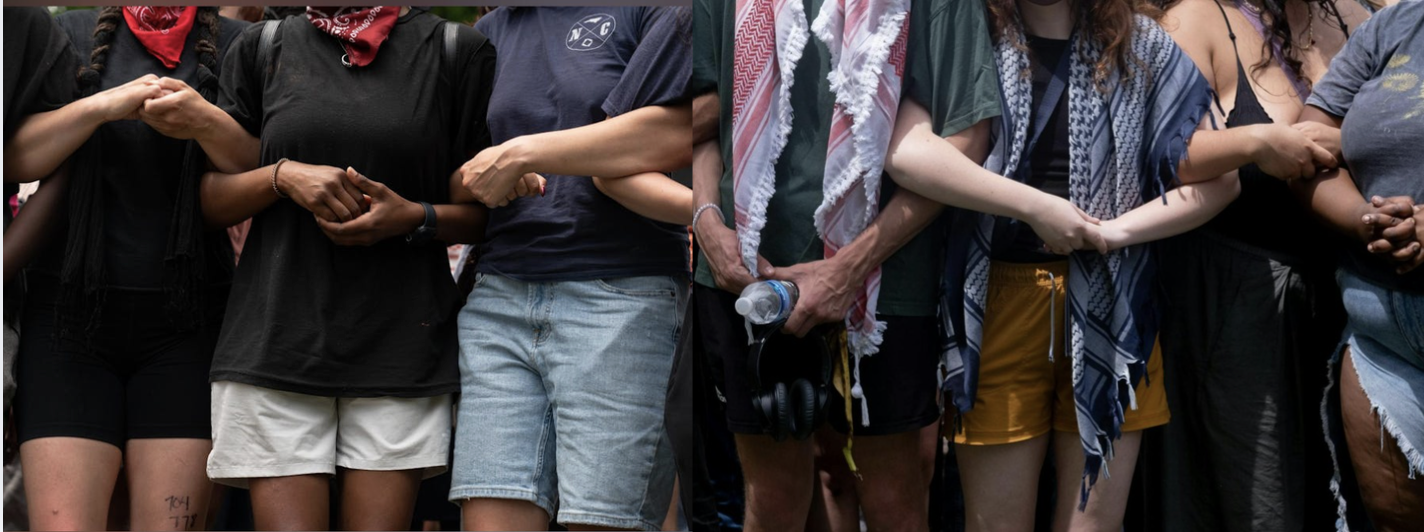
The image below is from February 19, 2024, during UNC SJP’s march on Franklin Street demanding that UNC do the same for the Israeli occupation.
The encampments drew inspiration from previous anti-war demonstrations on this campus. In the 1980s, students part of the UNC Anti-Apartheid Support Group built shantytowns on Polk Place in solidarity with Black South Africans’ Anti-Apartheid movement and demanded the University divest from South African Apartheid. Additionally, the extensive research and lessons from the Silent Sam movement proved invaluable for organizers, particularly in areas such as movement mentorship, masking practices, and navigating University surveillance.
So Silent Sam was before I was here, but a lot of people who been at UNC longer than I had and familiar with that history, were pulling on those connections and those histories, and were familiar with them, and especially the Silent Sam organizers created a lot of zine historical records and made themselves available to SJP organizers to share information, but also the broader Triangle organizing ecosystem as well. Because there are organizers out in Raleigh, there are organizers out in Durham, there’s an organizing community in Carrboro, and in conversation with one another. We’re going to each other’s protests. We’re working together. We’re sharing resources, we’re sharing expertise. — Sophia.
Beyond tangible lessons, this long record of movements passed a metaphorical baton to the next generation. These struggles signaled to future students that members of the university have a stake in this institution and that, through collective action, they can reshape the university’s landscape. Named “Polk Place” after James Polk, the upper quad has historically been a primary site of protest, and has repeatedly been reclaimed as a space of political intervention. In publicly reclaiming a space named after Polk, a “profit-hungry slave owner who tore families apart for personal gain,” students rejected this legacy embedded in the University’s landscape.60
“It was right in front of South Building. When they used to have the pavilion during COVID, they put up a big pavilion in the middle. Yo, this is crazy, actually, because that’s the same place the encampment was… Oh, damn, whoa. That’s interesting, because basically, they had this big pavilion where it was covered with a tent, it had a wheelchair ramp, and you could basically walk up there. And they had like areas for people to study. Because they wanted to offer people outdoor areas to study post-COVID. And so, it was literally, it might have been a little bit up from the encampment, but it was essentially, that same area in front of South Building.” – Derrick David.
UNC SJP, like so many student and campus organizations before them, re-prioritized and re-narrated Polk Place as a site of resistance, centering stories and histories that the University has long marginalized. Students inherit not only strategies but a responsibility to care for and actively shape the university’s future.
From the criminal charges and suspension of UNC SJP members to the removal of the Palestinian resistance mural, the University administration made countless attempts to squash the struggle for a liberated Palestine. But as Dinos Christianopoulos writes, “they tried to bury us, but they forgot we were seeds.” UNC SJP rooted itself within the University. In the face of the relentless repression, the organization found creative ways to continue campus programming and engage in cross-pollination work through other movements on/off campus. The University administration may have formally banned UNC SJP, but the subversive impulse to unapologetically challenge and negotiate power, alongside the steadfast commitment to build a more egalitarian world, germinated and blossomed at the University of North Carolina Chapel Hill.
“perhaps we must just exist on this lawn for a bit longer,
at the wrong times, with the wrong bodies.
Perhaps one might uproot the lawn,
and plant a native garden next time”

– an excerpt from Saanet “the emperor is all filler, the university has already fallen”