the Student Struggle Against the Re-Segregation of UNC Chapel Hill
Moving Forward
At the University, we spend countless hours reading and writing to produce transformative research, pour copious amounts of energy into campus organizations, and even create new initiatives to fill in gaps of what’s missing on campus. Our time and labor we put into this place all go into the hopes of enriching this place and leaving it better than we found it.
At the University, we spend countless hours reading and writing to produce transformative research, pour copious amounts of energy into campus organizations, and even create new initiatives to fill in gaps of what’s missing on campus. The time and labor we put into this place all go into the hopes of enriching this place and leaving it better than we found it.
The institution cannot love you. But the people can.
People mourn with candles and flowers during a vigil for Palestine on Oct. 7, 2024 in front of the Old Well. (Photo Courtesy Grace Richards)Mother and daughter embrace at a pro-Palestine rally outside of South Building on Thursday, Aug. 22, 2024 (Photo Courtesy Heather Diehl)Two UNC SJP members at People’s Graduation (Photo Courtesy Grace Richards)Two friends hug after prayer on Friday, April 26, 2024. (Photo Courtesy Heather Diehl)Protesters gather for prayer during Passover on Friday, April 26, 2024. (Photo Courtesy Heather Diehl)
My final act of love to the people of the University is gifting these stories to you. As Thomas King wrote, “the truth about stories is, that’s all we are.” The stories we tell and cherish shape how we live our lives, the values we hold, and how we see the world. He famously says, if you “want a different ethic? tell a different story.” So if we want to change our social reality, we must first change the stories we tell.
Coming here my first year, I was sold a meticulously crafted narrative of what the University is and what my designated role was in it. I was to attend large lecture halls in this globally ranked R1 university, watch nationally ranked sports games on the weekends in my Carolina blue attire, and drink from the Old Well on the first day of classes every semester for a perfect 4.0 GPA.
However, those things are not reflective of my time here at the University. I spend late nights in meetings at the Undergraduate Library with my fellow student activists, spend my free time making provocative infographics about our administration, spend afternoons digging through Wilson Library’s archives to learn about UNC’s past, and dedicate weekends to attending community events and rallies.
As I prepare to don my cap and gown this May, I depart this place leaving behind a different story of what this University is and what our roles within it are. For me and so many other young people, studying and participating in political student struggles revealed an alternative version of the University. One that produces a different type of knowledge and generates engaged informed citizens to ultimately bring about a new world.
What lessons might we take from these political struggles to meet the current moment?
“One of the most powerful things and elements of colonization is discontinuity. It’s breaking up traditions, breaking up ideas, and breaking up movements that are people-centered, that are working to disassemble this system that is not really affirming of love and life, not just for people that are, Black and brown, but also white people as well. They also suffer under the system. And so the first step is breaking that discontinuity.” — Sam Scarborough
Through its campus borders and social hierarchies, we are isolated, fragmented, atomized from one another. Our schedules and prescribed roles keep us apart, undermining the possibility of relationships and coalition-building. Additionally, the University’s rigid periodization of time historicizes campus events into controlled time intervals, cutting us off from the past.
Derrick Davis explains that this is not accidental.
“I think one of the biggest things I’ve learned, during my time, was that the University wants people to come into Chapel Hill and transition out without connecting to [the] community, like people who actually live there. Because when students start learning from people who actually live here, like, what’s been going on for all these years? For example, Mr. James Lewis Cates, when you hear that story, there’s so many people if you talk to in Chapel Hill Carrboro can tell you about him, but the University wants students isolated, so that they don’t know about these things, so that they can’t connect this memory that’s happened in the Pit to a deeper struggle for resistance. And also I feel like through Communiversity, I was able to connect with that because we’re literally working with students who are going to Chapel Carrboro schools, and so I’m also meeting their parents and it’s been like a full circle moment with that, because I’ve been able to now be part of the Chapel Hill, the greater Chapel Hill Black community. And I’ve met some students who I saw when they were seven years old, and now they’re in high school, and it’s just like a full circle moment of community. And I feel like those are the type of things the University doesn’t want us to have. Is the more time we have together, the stronger we are as a community. And there’s more incentive for me to live here. I’m sure the University probably would have wanted me to come through there, do whatever I did during my four years, but not tell anybody else. They don’t want conversations like this to happen, because it’s going to carry on this truth of what they’ve done to hurt people and harm people in this community, and so they ultimately just want people to come in, leave, and never come back and not share these stories. But this is a former resistance that can hopefully start to get some type of reparations for just all the harm that they’ve done.”
In keeping the movements separated and people isolated, the University is able to maintain a system of containment and control of bodies, of movement, of thought that all work together to keep the people on the campus separated, disciplined, and manageable.
But what happens when we refuse these divisions? When we disrupt those boundaries? When we start making connections?
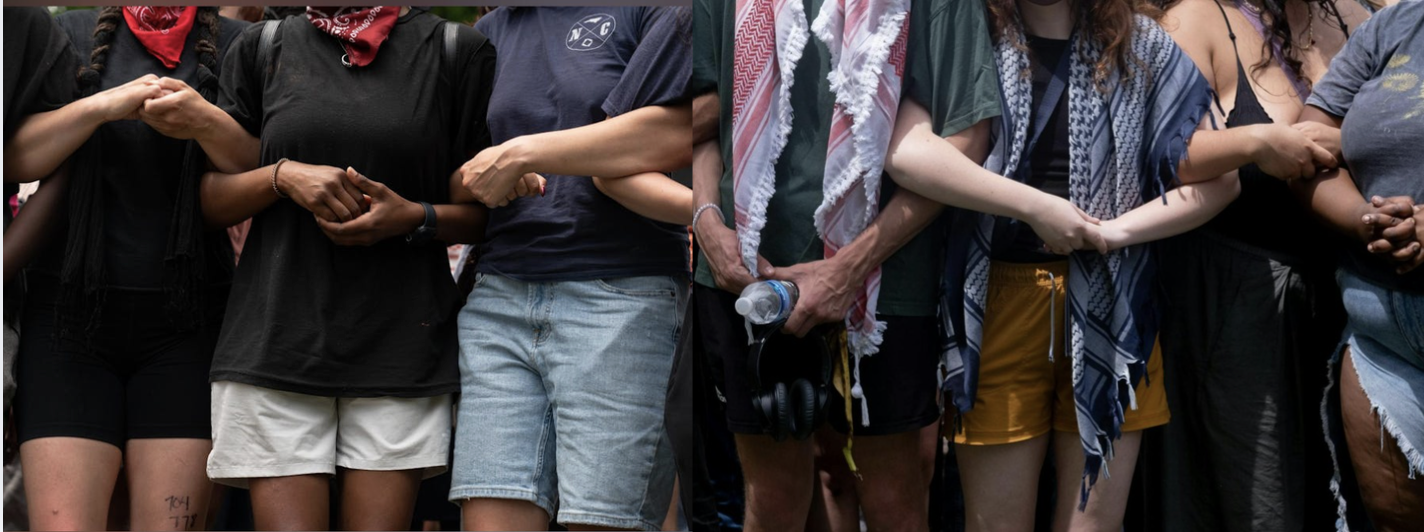
From exposing the inner workings of University governance and holding administrators’ feet to the fire to physically linking arms to protect one another from violent campus officers, student movements in the 2020s contested and refused these logics of isolation. They worked to dismantle the University as a location structured by physical wall and metaphorical borders.
In this process, students uncovered UNC’s racist history. Through digging through archives, learning about the past, and adapting similar organizing tactics, students reconnected to the long tradition of student activism and organizing on campus. From civil rights struggles and desegregation efforts to the Food Workers’ strikes and campaigns to rename buildings, the people of this University have consistently challenged its administration to confront its inequities.
Students, faculty, and community members have increasingly recognized themselves as part of this long, ongoing liberation struggle. Through this framing, students reattach memories of a shameful past to present-day physical sites, memories that have been scrubbed from public recollection and demand accountability and material reparations.
UNC SJP host “Disorientation Tour” linking different campus locations to important historical events (Photo Courtesy UNC SJP Instagram)
In rekindling a relationship with the past, we develop a new relationship with the University. One in which we recognize ourselves as active constituents with the power to shape its present and future, and inherit this responsibility to demand for accountability and towards this broader project of freedom.
TransparUNCy hosts their own Student Forum on University Governance to demand more student input in chancellor search. 0 members of the chancellor search committee show up. (Photo Courtesy of Faith Skowronnek of The Southern Student Action Coalition) Many students come attend TransparUNCy’s hosted chancellor’s search committee (Photo Courtesy of Faith Skowronnek of The Southern Student Action Coalition)
iAs we engage in this long-term process of freedom-making and work toward our goals of liberation, we must also confront the realities of the present. Often, stories of resistance are primarily focused on the dismantling of institutions which are important, but not lost on me are the stories and acts of care.
How do we hold each other at vigils in which the University has erected fences to disrupt our mourning?How do we tenderly care for the strangers that we just met? How do we celebrate one another when the University attempts to strip us of our futures?
As we struggle toward this liberated future, these acts of care make this inhospitable place more hospitable. The love and care for one another is why we keep showing up to teach-ins and rallies. It is why we stay until the crack of dawn, even with looming threats of cops armed with pepperball guns and zip-ties. In doing so, we attach new feelings and meanings to these sites tainted with violent pasts into locations of change, of communal resistance, and of endless possibilities.
In no way is this task easy. It is messy, inconvenient, and painful because the University was not designed for many of us or to accommodate the ideas we espouse. As Julia Clark explains, this University “was built by enslaved people for their enslavers. It was never built to be the University that it is today, with all of the diverse student organizations populations, with the student movement building and organizing, it was never meant to be that,” she continued, a University “built by enslaved hands, hands of the enslaved on a predominantly white campus that continues to remain predominantly white is something that we will have to fight for. It will not be given to us.”
From increased surveillance of classrooms and syllabi to ongoing budget cuts to its global academic centers, the administration is making its hostility toward marginalized communities evident and clear. These policies are not isolated incidents, instead reflect a broader logic of elimination that narrows whose knowledge and futures are permitted to endure at this University. Thus, a People’s University must be collectively demanded and built.
The student movements are not going anywhere. But they ask you to bear witness, it demands your attention, your presence, and your participation.
Because if not me or you, then who? If not now then when?