the Student Struggle Against the Re-Segregation of UNC Chapel Hill
The Student Response and Resistance
While affirmative action was a major stepping stone for the right-wing takeover of the University, the fall of affirmative action also catalyzed an era of student activism, which evolved into a larger movement of campus organizing and digital activism.
The purpose of this section is to provide a historical sketch detailing the work that student activists were doing on campus; simultaneously, it also aims to critically examine and unpack the multilayers of the University. The University exists as a space in which different groups of people have attached different meanings. For upper administration, who arguably have been captured by right-wing networks and activists, the University is a place to uphold the status quo and reproduce white supremacy. This is exemplified in the administration’s defense of the Confederate monument of Silent Sam and refusal to officially change the names of all campus buildings named after white supremacists and enslavers. Campus activists and organizers, however, understand the University as a site of alternative worldmaking. From the 1960s Food Worker Strikes to the 1990s Housekeepers’ Strike to the 2000s anti Iraq war protests, students and campus members have, time and time again, taken on the responsibility to imaginatively contest the upper administration’s vision of the University and tried to build a more equitable campus. In the subsequent sections, I examine how these discursive battles have unfolded through student movements, and how these movements have challenged the University administration and materially transformed the campus.
Contextualizing Student Movements
To fully understand the student organizing response to the bans on affirmative action and DEI, it is important to first contextualize previous movements that laid the groundwork and shaped the campus climate for the next generations of student organizers. UNC has a long-standing tradition of social unrest on campus; however, given the limited space and time, this section will focus on the immediate prior student movements before the fall of affirmative action and DEI.
These student and community-led movements are critical not only because they have materially transformed campus policies and the broader institutional landscape, but also because they have fundamentally reshaped what engagement and participation within the University looks like. These movements demonstrate that students possess the curiosity and capacity to shape their environment. The memories and stories are passed on to each new generation of student activists and organizers who draw from the people before them, building on their victories, learning from their losses, and carrying their work forward towards a more just and equitable campus.
Photo Courtesy of Julia ClarkPhoto Courtesy of Julia Clark
For Derrick Davis, a staunch student activist at UNC, the fight to remove Silent Sam was critical to his political awakening at UNC. This struggle altered his perception of the campus landscape and catalyzed a new relationship with the University.
“But I heard that Silent Sam fell within, what was it, I think it was on my FDOC it fell. And then the protests in response to that began happening. So that happened, and I mentioned going to Cosmic and Insomnia. So I used to walk by Silent Sam, not realizing it was a Confederate statue, and so I saw it on Snapchat News one day. I was just like, Well, damn. I was just like, well, that’s not surprising, but it’s still just sad that I didn’t know this. And so then after that, I was like, okay, I really want to be involved on campus in whatever way possible.”
Notably, as pointed out by Fryar, this labor for change on campus has been and continues to be disproportionately shouldered by Black students and campus members. During the late 2010s and early 2020s, Black-led organizations like the Black Student Movement and Black Congress championed the fight to transform the University into a safer environment for students.
During COVID, BSM supported its community in the face of the University’s negligent response to the pandemic, “we asked our network of community members to donate as much as they could, and we ended up with a mutual aid fund of over $40,000 that we were giving away to students. There was an application. It had maybe three questions: what is your PID, and how much do you need? We weren’t asking for justifications. There were people who needed money to pay rent. To get apartments. There are people who needed money to get Wi Fi and like high-speed Wi-Fi and laptops that they needed for virtual classes. There were people that needed money to get PPE or food. I mean, Black students were actively begging for help from the University, and nothing was provided. So BSM had to step in, and we filled the gaps. We, as a community and as an organization, filled the gaps and created campus safety more than any other institution at that time, affiliated with UNC Chapel Hill.” — Julia Clark.
Additionally, the Black Student Movement noting the issue of interpersonal violence and sexual assault rampant at the University became the first organization to establish community standards to protect people against interpersonal violence, racism, homophobia, transphobia, colorism.
“A lot of these abusers were walking around campus freely while their survivors were scared to come to events and scared to be members of organizations because of who was involved and who was there, and so even creating things like that, a mechanism to create safety at events, at organizational meetings, or even just determining what was acceptable and what wasn’t for a member, the university didn’t even do that.
The University didn’t even take action against abusers that were reported. And so once again, organizations like BSM had to step in.” — Julia Clark
It was students who uncloaked how racism continued to permeate University operations and policies. In response, these same students sought support from the wider community and built safety networks and policies to provide for and protect other marginalized students. In the face of the University administration’s nonresponses and negligence, students organized to shift the campus climate to become less hostile to marginalized students. Additionally, these organizations were not just supporting and protecting students, but working to transform the University for faculty and the wider community.
When Nikole Hannah Jones’ tenure was delayed, the Black Student Movement came to her support. In June 2021, BSM members were invited to a Board of Trustees meeting that was planning to discuss Nikole Hannah- Jones’ tenure. Despite being invited to this meeting, Julia Clark recalls the antagonism of Black students in attendance.
Julia Clark speaking at rally (Photo Courtesy of Julia Clark)
“I had worked with Board of Trustees members and spoken to them and been invited to this meeting, was a[n] olive branch that I was extending to people who, frankly, had very little respect for us as Black students or what we were fighting for, and so when they attempted to kick us out, I wanted to stand my ground. We were invited here. You cannot decide in the middle to kick us out when you asked us to be here. So we stood our ground, and we did not leave. And then they called UNC police or their security to come and start shoving students, putting their hands on students, to kick them out. And at that point, I knew we had to start recording. I told the people around me, start recording. And as we were getting pushed out of the space physically with the hands of police officers with doors that they were trying to close on people, and it got escalating more and more. I was screaming, to be honest. I was not screaming like “ah”, but I was screaming profanities.
And I definitely cussed out [former Chancellor] Kevin Guskiewicz. I definitely called him [a] b word to his face. I definitely cussed out the police officer, I believe he was a chief of police at that point [of] UNCPD, [Rasheem] Holland was his last name. I don’t remember his first name, but I was cussing him out too. I cussed out every single one of the Board of Trustee members…
And eventually, as I was in the doorway of the Board of Trustees chamber, and police officer Holland, was shoving me again and again, and he grabbed my arm, left bruises on my arm, and was trying to close the door on me. I don’t know what exactly happened, or if he got frustrated. I don’t know. All I remember is feeling a big fist hit me in the face, and it hit me so hard. He hit me so hard, I stumbled back, and I was wearing a mask. The mask flew off my face. I stumbled back, and I was just in shock, and at that point, because I had stumbled it was enough to close the doors and we were kicked out.” — Julia Clark.
Davis’ reflection on the treatment of Nikole Hannah-Jones and Black students exemplified another example of how white supremacy is entrenched in the University.
“It was just really sad, and I think about it now, we’re asking for you to give us money back, because you’re profiting billions of dollars off of this land that you stole and that you use free labor for, because we really should be asking for that. We’re just asking for accountability in this process, and we just want to be in on this meeting to hear. You’re going to deny this Black woman tenure and that’s where this whole thing happening was just a multi-level representation of this is a shitty place, and just very entrenched in white supremacy, because you have people, you have community forming against the institution and trying to do something right and take power back. But ultimately, when the University is just doing what they do, they are just causing violence.
When the University administration failed to support its students or acted with hostility towards them, students disrupted the University’s power structures and took matters into their own hands. They raised funds to ensure their peers could afford basic necessities and establish community guidelines to create safer, more supportive spaces. They put their bodies on the line to directly confront their University administration and demand accountability.
Julia Clark points out the contradiction where “everything that is done in opposition to the university is done for the sake of progress, yet “the University tries to frame student activists and student organizers and organizing collectives as enemies, when actually we are the only reason that students continue to come here.” In fact, in many of the oral histories I collected, student organizers referenced earlier student movements as part of what they had learned about UNC prior to their arrival, and sometimes as the reason they came to the University.
“I guess part of the [first] impression with that was I was really amazed at how much students were involved in the Nikole Hannah-Jones situation. Because I feel like a lot of reporting, more national coverage of it seemed to just focus on her. But then being from North Carolina, and not that far from Chapel Hill, I was hearing a lot more from what students were up to, and what campus life was like. It was just cool hearing about the protest with the Board of Trustees or Board of Governors, whichever one it was that action had happened. And it was just cool to see how activated students and campus generally were. I always [had] kind of been not a leftist, but always been left leaning. And I think all throughout high school, I kind of had a trajectory of going further and further left. But 2020, especially radicalized me. And that was that same era. So yeah, I think all of it coming together was I want to go join all the students at UNC that are doing cool stuff. And shouldn’t there be a really engaged political community on campus. I thought it just made sense.” — Tico
“There was an attempted crackdown by the Department of Education related to some event around Palestine in the Center for Middle Eastern Studies. And the reason I knew about it is because my undergraduate mentor was kind of plugged in to Islamic Studies and heard about it, and I think it was the UNC Duke consortium or something, and so that kind of repression. And then Nikole Hannah Jones being denied tenure as a punishment by the Board of Trustees for her work on a publication with The 1619 Project. And so before I came here, I emailed the program that I was a part of, and here are these things I’ve heard. Will I have academic freedom when I go here? And the student services manager had a pretty even-handed response, where he was like, I do not foresee this a problem during your time here, which I think, looking back on it now, he didn’t foreclose the possibility.” – Sophia.
In spite of the University administration’s continuation of structural violence, many students recognized that as members of this campus, they shared a responsibility to continue this unfinished project to make University into a habitable and accommodating place for all its current and future constituents.
Organizing in the Aftermath of Affirmative Action & D.E.I Ban
In November 2014, Students for Fair Admissions filed a federal lawsuit against the University of North Carolina Chapel Hill, alleging its use of affirmative action violated the Equal Protection Clause of the Fourteenth Amendment. For the next decade, as the University battled in federal courts and the Supreme Court over the constitutionality of its use of race in its admissions, UNC students relentlessly came to its defense. For example, in 2017, 8 Black and Latino UNC students and alumni were granted special status to intervene in the case. These students provided testimonies on how race-conscious admissions increased racial diversity on campus, outlined through their lived experiences of how racial discrimination continued at the University and argued that the ban on race-conscious admissions would harm the campus’ educational environment. 1Lawyers’ Committee for Civil Rights Under Law, Lawyers Committee, March 4, 2019, https://lawyerscommittee.org/wp-content/uploads/2019/10/UNC-Declaration.pdf.
After these eight students graduated and alumni departed from the University, a new group of students stepped forward to defend affirmative action. In the fall of 2022, a collective of first-years and sophomore students on campus formed a new student organization, the Affirmative Action Coalition, with the mission to work towards “securing equal access to education for all students by preserving the use of race in college admissions and targeting inequities confronting students of underrepresented and resilient backgrounds.” Notably, this organization was co-founded by myself and three other Asian American students who publicly rejected Ed Blum’s arguments that affirmative action policies were discriminatory towards Asian Americans and called out the weaponization of the Asian American community as a political wedge for a larger conservative agenda.
(Left to right) Adela Zhang, Joy Jiang, me and Sarah Zhang pose for a photo for WUNC after founding the UNC Affirmative Action Coalition. (Photo by Liz Schlemmer)
“It’s appalling to me that, as a student and just as an Asian American person, that we treat higher education as this sort of meritocracy, as if it was always just about the best of the best attend these “best institutions.” And it was also appalling to me that we treated this form of acceptance into these already deeply discriminatory places that are built on discriminatory practices. But that’s a whole other story, that we treat these places and this game that is college admittance as a zero-sum game that somehow bringing on students who have historically faced outright suppression from these institutions is in some capacity going to harm students who have not.” – Pragya
Two months after the formation of the coalition on October 31, 2022, representatives of the Affirmative Action Coalition joined students from across the country, such as Harvard, Yale, and UC Berkeley, to rally in solidarity in the nation’s capital in support of affirmative action.
Students from universities across the country like UNC, Harvard, Yale and UC Berkeley rally on the steps of the Supreme Court for oral arguments on October 31, 2022
The day before the Supreme Court oral arguments, a group of civil rights organizations hosted “Affirm Diversity.” At this event, Floyd McKissick Jr. who was a former UNC student spoke about his father, Floyd McKissick Sr., one of the first Black students to attend UNC and worked to desegregate the University system. His remarks were a stark reminder of the temporal proximity of how little time there is between the legal integration of higher education and the present generation. With only about 1.5 generations separating these moments, McKissick’s remarks spoke to the precarity of progress and revealed how quickly the University was to withdraw the advancements to civil rights.
Floyd McKissick Jr. speaking at the “Affirm Diversity” event in DC
On June 24, 2023, the Supreme Court of the United States ruled in favor of Students for Fair Admissions, finding that affirmative action policies at Harvard and UNC violated the Equal Protection Clause of the U.S. Constitution and Title VI of the Civil Rights Act of 1964. This ruling effectively gutted affirmative action and ended the use of race as a consideration for college admissions. Students from marginalized communities across the country voiced their disappointment, but were not surprised by the outcome.
“And so I didn’t see a lot of shock from my experience from the affirmative action decision, and I felt like it was going to be one of the tipping dominoes, if you will, for not just race-conscious governance at Carolina, but also DEI policies, all of those things. And it’s a lot easier to say that in hindsight, but I will say in that moment, there was still a feeling of anytime I’m on this campus, this is not a space that is safe for Black people. This is a space that has made it abundantly clear– we can work to build this university, brick by brick, we can work to build this University through the athletic program, we can work to build the university through our scholarship and our research, But at the end of the day, whether we’re in the dining halls, whether we’re the architects of the buildings, whether we’re the players that are making the school billions of dollars, Black people do not matter to this University. And that was something, I wish that it was different, but that’s just how the institution has worked since its inception, and there has not been an incentive to change fundamentally there.” – Sam Scarborough.
In response to this ruling, a coalition of UNC student organizations issued a collective statement expressing disappointment but more importantly emphasizing that the fight was far from over.
“We grieve together. We fight together.”
Student organizations respond to the Supreme Court affirmative action ruling on June 29, 2023
Despite the devastating ruling, UNC student campus leaders were committed to advancing educational equity at the University. Upon returning to campus after the Supreme Court decision, the Affirmative Action Coalition reoriented their activism towards political education and hosted a summit. On the cold winter morning of January 2024, the Educational Equity Summit: Post-Affirmative Action Advocacy brought together students, professors, scholar activists, and community organizers across the campus community to discuss the implications of the Supreme Court ruling and what it meant for the higher education landscape.
(Photos Courtesy of Affirmative Action Coalition)(Photos Courtesy of Affirmative Action Coalition)Photos from Educational Equity Summit (Photos Courtesy of Affirmative Action Coalition)Photos from Educational Equity Summit (Photos Courtesy of Affirmative Action Coalition)Photos from Educational Equity Summit (Photos Courtesy of Affirmative Action Coalition)
Over the next year, the Affirmative Action Coalition remained active and steadfast in its commitments. After many internal conversations on how to effectively further equity on campus, they launched a new political project: TransparUNCy. Because of the way University is structured, undergraduate students’ primary goal and focus in college is receiving their degree at the end of their four years. Therefore, a majority of students go through college without understanding how their University functions, how decisions are made, and who their administrations are. Besides an occasional Outlook email and viral Daily Tar Heel Instagram post, the undergraduate student population is ostensibly removed from University governance and politics.
Recognizing this, TransparUNCy was founded to bridge this gap between the student campus culture and university governance by demystifying university politics and clarifying how university governance operates. Their tag: who controls your education, how they do it, and what they don’t want you to know.
TransparUNCy was created on the idea that the overturn of affirmative action was one small stepping stone in this broader right-wing takeover of higher education. And the intent, even behind the name, was that it is true that most students don’t know or don’t care about any of this, about what we call institutional governance and the political underpinnings of institutional governance. Because why would they? It’s one of those questions I come back to often. If I think back to being a freshman at this institution, the freshman who was going to every UNC sporting event, painting myself blue head to toe, wearing my blue wig, there was no world in which I was sitting there thinking about who was controlling my education or whose money was quite literally deciding, what the value of my degree was going to be in 10 years. – Pragya
Primarily through teach-ins and social media posts, TransparUNCy used everyday language and digestible media to articulate what was happening at UNC to outline why students were implicated and needed to care. Regardless of who you were, TransparUNCy opened its doors to everyone who was willing to listen and learn. Commit an hour of your time, and be guaranteed that you will leave the Student Union having learned something new about your institution and having had some good laughs.
In its first semester, TransparUNCy ignited a campus-wide buzz: sartorial flyers were taped everywhere, from campus buildings to Davis Library bathroom stalls and viral eye-catching Instagram posts. This relentless in-person and digital promotion was successful; flyers were impossible to miss, and curious students crowded into standing-room- only student union rooms to learn about a range of contemporary issues.
TransparUNCy fliers
“The idea was that having a packed room and some people who had to stand because there weren’t enough seats was the environment that created discussion. That was the environment where people kind of weren’t sitting apart from each other, or weren’t quiet. And it sounds kind of ridiculous to say that that could change the entire vibe of the teaching, but it is really true that all the teach-ins that we had a full room were better than all of the teach-ins where we did not have a full room, really, without fail. And so I say, the vibe of a teach-in is you give people some grace, showing up late, and you start maybe 5-10 minutes after people arrive. People have time to meet each other and chat, but the presentation style was very informal. Plenty of profanity, plenty of jokes, plenty of funny tweets in the slides. Really no formality to it at all. The point has always been that we, as the presenters, our students, who have recently stumbled upon this information, found it incredibly surprising, absurd, and we must pass it on to you, because it’s so interesting. And so that was kind of our disposition at the beginning of TransparUNCy, we found that it worked well. And so it’s kind of the vibe that we tried to keep always.
But yes, we do about 45 minutes of presentation. We’d stop maybe every 10 minutes to field questions. And then once we hit the 40 or 45 minute mark, we would do 5-10 minutes of discussion, everybody at the same time, talking with your neighbors, meeting new people, talking about what you thought about the material, and then we would open it up for the last 10-ish minutes for open discussion between everybody, so that everybody could listen or questions for the presenters at the at the very best teachings, we were kicked out of the room by the employees of the Student Union because we went over on time. And then the conversations would spill out into the hallway of the Student Union, and people would stay for 30 more minutes to talk about the material. And so I’d say of the ideal teach-in, of the best teach-in that was the vibe” – Julian
Standing Room only TransparUNCy Teach In
The popularity of these teach-ins soon made its way to South Building. One of TransparUNCy’s first campaigns was making visible and widely known the “non-partisan” interim chancellor’s connections to right wing organizations, specifically interim chancellor Lee Roberts received income from far-right megadonor Art Pope’s company. On April 4th, Lee Roberts attended TransparUNCy’s second ever teach-in. Students in the audience pressed Lee Roberts to address the room. He was asked if he would support following Florida’s anti-DEI path. He responded, “I don’t know anything about the Florida legislation.”2TransparUNCy, @TransparUNCy. 2024. “Ignorance is bliss, Interim Chancellor.” Instagram, April 8, 2024. https://www.instagram.com/p/C5geQhyuDRW/?igsh=MWpuNWY3em9hdG4xdg In response, the room erupted in laughs and snickers at his response.
“Ignorance is bliss, Interim Chancellor” (Photo Courtesy of TransparUNCy Instagram)Florida DEI Ban Headlines (Photo Courtsey TransparUNCy)
The immediate week right after Lee Roberts professed ignorance of University DEI bans at the TransparUNCy teach-in, members of the Board of Trustees disclosed in a media interview that there was a plan to meet and advocate for the removal of DEI efforts from the UNC budget.3Joe Killian, “UNC-Chapel Hill Trustees Could Begin to Defund DEI Efforts • NC Newsline,” NC Newsline , April 11, 2024, https://ncnewsline.com/2024/04/11/unc-chapel-hill-trustees-could-begin-to-defund-dei-efforts/. A month later, on May 13, 2024 UNC-CH’s Board of Trustees voted to defund $2.3 million in DEI initiatives and divert it to “public safety”, including UNC police.4Brianna Atkinson, “UNC-Chapel Hill Bot Votes to Divert Dei Funding, Redirecting It to Campus Public Safety,” WUNC, May 13, 2024, https://www.wunc.org/education/2024-05-13/dei-unc-chapel-hill-trustees-vote-redirect-funding-police.
Lee Roberts was appointed Interim Chancellor, things started changing really fast, because the Board of Trustees and Board of Governors knew that they had an ally in the chancellor, and I think that really changed everything. And so from what I can remember, DEI was the first thing that they came after, or the first major thing that they came after, and I remember it being a very political thing nationwide, and something that people were talking about. And I feel like some students were maybe even surprised that it came to UNC Chapel Hill, because the places in the news were Florida and Alabama. Mostly I think Kentucky also had a bunch of headlines. And I remember at one of our very first teachings, I think the second teaching he ever did the Chancellor came and made an appearance, and he was pressed on the issue of DEI and he could not take a stand. He could not even acknowledge that he knew the campaign around removing DEI programs on campus, and it was blasphemous. He couldn’t give an answer. And literally, that next week, the Board of Trustees and Board of Governors made huge, huge measures to strip DEI which they eventually did. — Julian
The University System Ban on Diversity Equity and Inclusion (DEI)
Between April and May 2024, the UNC Board of Governors passed numerous resolutions dismantling DEI. These decisions sparked major outcry across all 17 UNC universities, especially at UNC-CH, which led all NC public universities in DEI cuts with 20 eliminated positions and 27 realigned positions. These massive cuts revealed that the University was not just complying with the new policies, but was an active leader driving the shift across the UNC system. 5Brianna Atkinson, “UNC-Chapel Hill Leads All NC Public Universities in Dei Cuts,” WUNC, September 13, 2024, https://www.wunc.org/education/2024-09-13/unc-chapel-hill-dei-cuts. These massive cuts revealed that the University was not just complying with the new policies but was an active leader driving the shift across the UNC system.
Students of color immediately felt the impact of the affirmative action ruling and DEI bans. Sam Scarborough, in an article with WUNC, voiced that in 2023 he would have been one of four or five Black students in his classes, but in 2025, he was lucky if he was one of two.
“Being one of one is a drastic shift. Although that might not seem a lot, a decline of one to two people in the classroom, it does mean a lot in your day-to-day experiences,” Scarborough said. “This university that is supposedly representing this diverse state of North Carolina only has less than 8% of its incoming enrollment – both this year and last year – being Black students, even though we make up roughly 20% of the state. I think that’s devastating, and I think that’s a contradiction of values.”6Brianna Atkinson, “Two Years on from Supreme Court Decision, Black Students Feel Less Welcome at UNC-Chapel Hill,” WUNC, December 8, 2025, https://www.wunc.org/education/2025-12-05/black-students-unc-chapel-hill-feel-unwelcome-supreme-court.
It was not just a decline in the Black and brown student population, but the ongoing national and university-wide witch hunt resulted in heightened surveillance of classrooms teaching about race, gender, and sexuality. Faculty and administrators were being monitored, syllabi were being mandated to be made public, and course names were being pressured to be changed. In response to allegations that the UNC Law School directed faculty to rename classes like “Black Lives Matter and the Law,” an anonymous group of students put up fliers demanding their administrators:
For nearly a decade, the University poured millions into defending its affirmative action policies. When those policies were ultimately gutted, the administration abandoned commitments to educational equity and racial diversity, and instead seized the moment to roll back racial equity and integration efforts. Alternatively, it was the students who took up the mantle to uphold commitments to diversity and justice.
Student Response to DEI Bans
Photo Courtesy of Brianna Atkinson/ WUNC Photo Courtesy of Sofia DiStefano / Niner TimesStudents from across the UNC System hold a rally ahead of the BOG vote in Raleigh on May 23, 2024
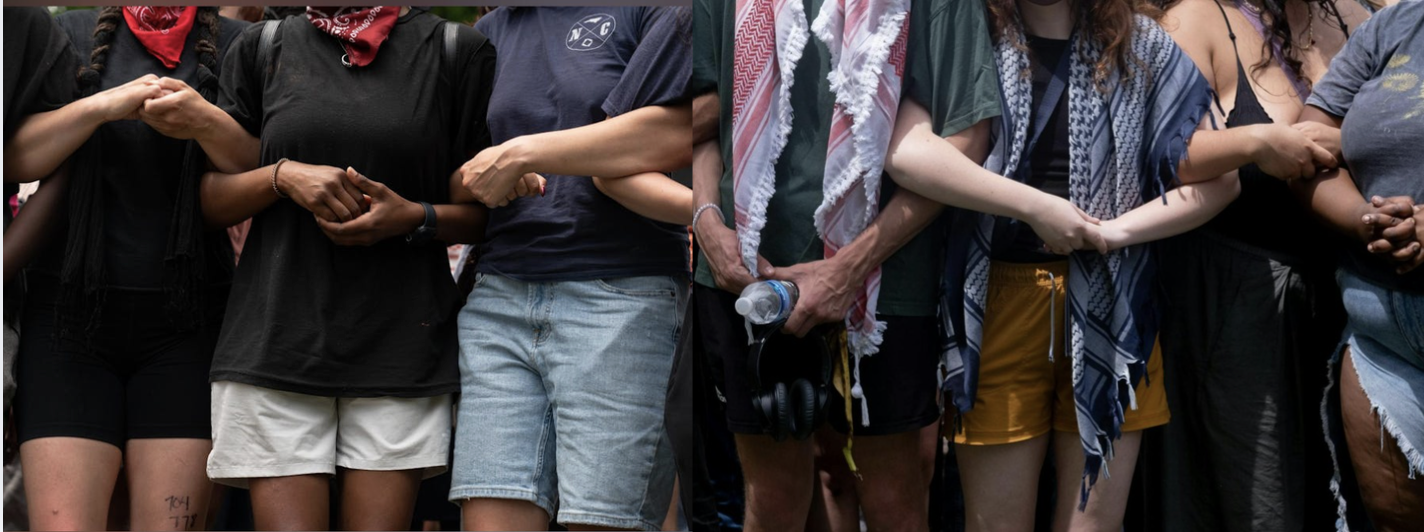
On May 23, 2024, university students from across the state, such as App State, N.C. A&T, N.C. State, and UNC all rallied in Raleigh to protest the Board of Governors (BoG) meeting. Despite these meetings legally having to be public and the decisions implicating students’ education across the state, the space was not accommodating to the public or students. Sam Scarborough explained the building’s layout.
“The way the building was structured, it’s crazy, because it wasn’t a fully public space. So it wasn’t a fully publicly accessible space. It was in the Dillon. The name is something Kane, not to be confused with Citizen Kane, but it’s something Kane, I think it’s his name. He’s a prominent Republican donor, all those things. He owns the Dillon building. It is private property. The UNC system office is on the 17th floor of that hotel kind of building. And the only way to get up there is you go up the elevator nine floors, and then you have to cross over in a breezeway, basically, and then take another set of elevators. The problem is, as soon as you get up to the ninth floor, all of the UNC system security, as well as they brought NC State Police, [who]were just sitting there preventing people to, again, be present in the room when decisions are being made about their lives.”
While at the protest, Davis expressed this frustration at the inaccessible meeting space, remarking, “how intentional these systems are in creating power, and upholding that power, because the Board of Governors meet in a private residence area in downtown Raleigh, and so basically, they do that intentionally, because they can trespass you. Essentially because it’s private property, they can easily tell you, oh, you can’t be here whereas, if you’re at UNC, you could say, oh well, I’m allowed to be here as a student.”
Despite the location being inaccessible and the “militarized presence” of law enforcement officers, students were determined to attend this meeting where big decisions about their education were being made.Pragya8, interview by Christina Huang, January 22, 2026, Oral History Interview, Huang American Studies Senior Thesis, Chapel Hill, NC Their presence at the meeting was promptly met with threats of arrest. Despite eventually getting inside the elevator to leave, both Scarborough and Davis were violently arrested.
Derrick Davis showing police officers “DEI Mattters” when asked to leavePhoto Courtesy of Sofia DiStefano / Niner Times
“And so while I’m in the elevator, I’m speaking very loudly. I’m not making any threats to anyone. I’m not throwing any punches. I’m just speaking my mind and saying, Look, this is bullshit. What are we supposed to do? You tell us that we need to be civically engaged, that we need to be aware about what’s happening – all these things. When we actually apply that in real time, you deny us the right to be in the room. And so, as I’m saying this, the elevator door is not closing. I believe it’s from the police officer, because his foot was actually by the door of the elevator, and so we couldn’t get it closed. So after about the second or third time, they just pulled me out of the elevator, and my good friend and comrade, Derrick Davis, was there trying to hold me onto the elevator that they told us to go down, and he ended up getting arrested too. And I want to say it was about seven or eight cops that it took to bring us down, and they tried to tell us what the charges that we were resisting arrest.
But if you look at the video, I look what is the statue in Brazil, Christ the Redeemer? Not that, but I look like Christ. I have my hands out, my arms straight out, so I’m in a very passive position. I’m not attacking, I’m not grabbing, I’m not doing anything. I’m literally just standing there. And that’s basically what happened. And I’ll never forget when I went to the car, we were on the way to the car, and they were searching us down, doing the very intrusive things that they do. I was like, look are you going to even read me my rights? The officer was like, “your rights don’t even matter, bro.” So, I remember that, and I also remember, funny enough, when we stopped right outside of the Wake County Detention Center, the police officer struggled to spell “protester” like he could not spell the word “protester,” and I was in the back with Derrick Davis just laughing there, like these are the types of people that are given more power in this situation than the people that are actually putting money in dollars and institutional benefits to the UNC system. We don’t have power in a situation, but these people do.” – Sam Scarborough
“And so basically, we all get into the elevator, and he’s talking his shit by saying, excuse me… I forget what it was, but he was just talking to him, it wasn’t something like… it was on some like, “Y’all are meant to serve us and we should be allowed in this meeting.” And basically, I can just share it. Did you ever interview Sam? Also, yes. Okay, so this is the wildest part, which I don’t even know if I’ve told him this for real. Yeah. So they were pushing us out. And so I’m by the elevator buttons, and he’s talking his shit. So I was like, you know what? Let’s keep this going. And so I leave the I’m pressing the button to keep it open. And then after a certain point, they’re like okay, let’s just get them. And they come into the elevator and try to take us out. And so I’ve gone through organizing training before, so I know to grab them by the waist to try to keep them. But then it was just me and him, and nobody else in the elevator was also doing that. So then it worked a little, but then it was like four of them, and they ended up pulling us out, piecing us apart, and slamming us to the ground and arresting us.
And so that happened so quick that I didn’t even know what fully happened, but I just know I started yelling like, “for being in the elevator?” Like we weren’t doing anything, we were literally just talking like we could have been doing worse things, like breaking things, and that’s just where I think it’s so wild that people try to tell you you’re supposed to protest a certain way. Yeah, people tell you you’re supposed to react a certain way about things. But none of that matters, because these systems will literally do whatever they want to you when they want” – Derrick Davis
Police shut down the jail citing a “threat to the building” after 2 students were arrested and refused to let people onto public property for loved ones to provide jail support (Photo Courtesy of The Southern Student Action Coalition)
In response to the brutal arrests after students were denied entry to a “public” UNC Board of Governors meeting, students immediately rallied for action. The Southern Student Action Coalition (SSAC), a “intersectional, intergenerational, and anti-imperialist action, rooted in the South’s progressive history,” helped organize the May 23, 2024 protest against the BoG meeting to ban DEI and outlined the implications of the BoG decisions. In a statement, SSAC illuminated that the decision made by “the predominantly white UNC Board of Governors, appointed by the overwhelmingly white North Carolina General Assembly” to repeal “a policy meant to support marginalized students and arrested two Black students who were unlawfully denied entry to the public meeting where the vote was being conducted” was an attempt “to silence Black voices and overturn any advancements from the Civil Rights movement.”
Public Statement following UNC System Ban and Arrest of 2 Students (Photo Courtesy of The Southern Student Action Coalition)
In response to these attempts to control campus demographics and policy direction, student campus leaders raised awareness and organized collectively to hold the institution accountable, confronting racist University decisions and creating student-led educational spaces that empowered other students to get involved.
With this emergence of new digital, physical, and intellectual spaces, a collective political consciousness began to develop on campus. Through opinion pieces, infographics, flyers, and direct actions, students articulated connections between University administrative decisions and policy changes as efforts to reinforce structures of white power on campus.
Flyers handed out during disruption by UNC SJP members at budget and finance committee meeting in response to Board of Trustees vote to defund DEI. Protestors chanted “disclose, divest, we will not stop we will not rest” while being escorted out by police. (Photos Courtesy of Brianna Atkinson)
Because the attacks on DEI were occurring simultaneously with Pro-Palestine protests, it was largely the same networks of leftist students working together to hold the administration accountable. Through this collaboration, student organizers began to draw connections between ideas of racial hierarchy and the imperialist global order.Students also began to link struggles for liberation at home and abroad, expanding their organizing to fight for a broader, wider idea of freedom. In the next two chapters, I will continue to expand on these ideas of interconnected struggle for liberation.
TransparUNCy Instagram Post following UNC System Ban on DEIFinal Slide of TransparUNCy Instagram Post following UNC System Ban on DEI
Many students, staff, and faculty lost faith in their administration, and realized it was up to them to fight for their future.
“To Peter Hans, Lee Roberts, and the members of the BoG and BoT,
As a student, I am sick of you pretending to be neutral and I’m even more disgusted by what you won’t admit is racism. Stop saying you are neutral on genocide when you fund it; stop saying you value this university’s history of student protest while proving you would’ve brutalized decades of student activists just the same as you have now; stop insisting you care about your students and then only listening to the ones who benefit from the white supremacy you protect and maintain. While you may attempt to utilize language neutrality, your intentions are comically and thinly veiled. Your anti-DEI, anti-student organizing, and pro-genocidal funding efforts are not neutral. Your students see right through you and history will not remember you kindly.”
Instead of relying on their University administration to change, the people of the University – in keeping with UNC’s long tradition of organizing – put their studies and bodies on the line and spearheaded the struggle opposing this return to ethnonationalism and white supremacy.
“‘Your voice matters; your action matters’ said Rose Benton, a fourth-year student at Appalachian State protesting this BoG meeting. ‘We need you to come in and step up and be another voice, be another body. This is not just limited to diversity and inclusion. This is a broad-based movement for the ability of students to decide what their education looks like and what their university is doing with their money. This is not a limited thing. We need people; we need to act’.” 9Sofia DiStefano, Davis Cuffe , and Sunnya Hadavi, “Protests Begin at UNC Board of Governors May 23 Meeting; Police Escort Protestors out and Arrest 2 | News | Ninertimes.Com,” Ninertimes, May 23, 2024, https://www.ninertimes.com/news/protests-begin-at-unc-board-of-governors-may-23-meeting-police-escort-protestors-out-and/article_c6b76142-1915-11ef-a21a-fb6bd72b6b2d.html.
Conclusion
What began as a student organization campaigning to “affirm diversity” quickly evolved into a broader student movement that transcended the politics of representation and inclusion. Student activists recognized and publicly acknowledged that affirmative action and DEI, initiatives were not silver bullets, but relentlessly defended these policies because they symbolically represented commitments to addressing larger systems of oppression that discriminatorily kept Black and brown students out of educational institutions.
In the aftermath of the affirmative action bans and gutting of DEI, students recalibrated and turned their attention to addressing the deeper structures of inequality embedded in the University itself.
The University’s antagonism and attempts to resegregate the University fueled a student-led movement to reclaim control over their education. University students are pressured to prioritize grades, accolades, and career advancement; however, during this time, students instead devoted hours to questioning what counts as valuable knowledge, who defines it, and how it’s disseminated on campus. Students and student organizations leveraged their campus platforms and social media accounts to expand political consciousness of the wider student population and shift the campus zeitgeist. TransparUNCy student organizers recognized that lecture halls and classrooms were not the only spaces of learning and instead used teach-ins, videos, and Instagram infographics to share information with the wider student population.
In doing so, they carved out their own spaces of learning and forged alternative modes of study and knowledge production. Through their work, they were subverting the rigid power dynamics of the University. Universities are hierarchically structured, with administrative authorities concentrated at the top wielding all the financial and political power and undergraduate students positioned near the bottom. It is important to note that undergraduate students hold more political and social influence than graduate and campus workers, which speaks to the nuanced dynamics of campus politics. Student organizers recognized that they were not compelled to passively accept the University’s actions. Rather, they actively rejected the administration’s vision of what the University should be. Strategically, they subverted the institutional power structure and constructed alternative and collaborative spaces led by students designed for the wider campus community. From the physical space of the student union to the digital comment sections of TransparUNCy’s Instagram, these sites allowed the spread of shared ideas, cultivated collective solidarity, and fostered social relations not only among undergraduate students, but also among graduate students, staff, and faculty. Together, these groups, who would otherwise be isolated from one another, banded together to negotiate their relationship with the University and collectively change its landscape.
Only a few years after the implementation of the affirmative action and DEI bans, their long-term effects are still unfolding. However, the immediate impacts are already visible on campus, including declining enrollment among students of color and continued attacks on courses that engage with race and related scholarship on equity. In response to these changes, students banded together to build alternative, welcoming spaces of education and support to confront these intensifying racialized antagonisms.
With these new physical and intellectual spaces for sharing ideas and collective discussions, students were able to expose the University’s ongoing white supremacist project and worked to challenge the legitimacy of the administration’s authority. In doing this work, students adopted a whole new way of understanding and interacting with the University.
“I love this University. I love this University with my whole heart. It has brought me the most transformative experiences of my life. I really think that my life has changed in so many ways over the last few years. I don’t do this work, and I don’t participate in these organizing activities, and I don’t spend my days going to a rally and sitting through three- hour-long faculty council meetings, because I hate this institution… I think it’s if there’s something deeply patriotic about you speaking truth to power and critiquing the place you’re from… It’s changed my worldview in a lot of ways, to be critical and to think in in critical ways, while still appreciating how much good has come of this space, and how much good we’ve been able to do as a result of this space.” – Pragya
Students contesting and dismantling the University administration’s power were not interested in accumulating this institutional power. Instead, they sought to transfigure the campus into a space where students and community members could reshape their relationships with one another and the University. In doing so, they collectively transform how they all interact with the world.