the Student Struggle Against the Re-Segregation of UNC Chapel Hill
History and Timeline for UNC SJP
Far too often, the narrative of the contemporary student movement for a liberated Palestine begins on October 7th, 2023. However, like many chapters across the country, UNC Students for Justice in Palestine (UNC SJP) existed on this campus for over a decade before their rise in mainstream popularity in October of 2023.
UNC Students for Justice in Palestine began in 2010 and was later revitalized in 2022. Lily helped revive UNC SJP in 2022 and later served as its president. She explained that through the support of faculty like Dr. Elyse Crystall and graduate students who were present at its inception that UNC SJP was able to be revived.1Lily, Interview by Christina Huang, March 6, 2026, Oral History Interview, Huang American Studies Honors Thesis, Chapel Hill, NC
The organization in its inception was relatively small in membership, but connected to national chapters at other colleges and Universities. Most University students and the public at large were not aware of what was going on in Palestine, so the initial work of UNC SJP largely focused on educational awareness and interest in Palestine, with their demands following the global Boycott, Divest and Sanctions (BDS) movement.2Tico, Interview by Christina Huang,January, 28 2026, Oral History Interview, Huang American Studies Honors Thesis, Chapel Hill, NC BDS is a Palestinian-led, global campaign started in 2005 to pressure the Israeli government to end its illegal occupation of Palestine.3“What Is BDS?,” BDS Movement, March 28, 2024, https://bdsmovement.net/what-bds The BDS movement calls on people to financially withdraw from corporations that support and invest in the State of Israel to economically pressure the end of the Israeli settler colonialism, occupation, and apartheid in Palestine.4Ibid
During this time, the organization did not garner large public support or antagonism from the student body or administration. Notably, the University administration left UNC SJP alone in its reemergence because they viewed the organization as non-threatening due to its small membership.5Lily, Interview by Christina Huang, March 6, 2026, Oral History Interview, Huang American Studies Honors Thesis, Chapel Hill, NC
It is important to note that, despite the small membership and small public visibility, this work was essential for the organization’s future. These organizers were doing the work of what UNC SJP member Sophia described as “hearthkeepers.” Hearthkeepers are the people who uphold the place of care when a movement’s momentum slows; the people who remember the stories and preserve group identity to keep the pulse of the community alive. They kindle and nourish the organization for future generations. 6Sophia, Interview by Christina Huang, January 15, 2026, Oral History Interview, Huang American Studies Honors Thesis, Chapel Hill, NC
“And I want to emphasize a lot of the narratives and attempts to discredit and delegitimize SJPs, but the Palestinian Liberation Movement, more broadly across the United States, is we’re paid or something, or we were hopping on a bandwagon or whatever. But SJPs have existed for many, many years when Palestine is not in headlines and stuff, and this SJP chapter has. And I want to emphasize that because I’ve been thinking a lot about hearthkeeping. Do you know what a hearth is like? A fireplace in a home that you tend to maybe you cook there, it keeps the space warm. This idea of even when the headlines and attention are elsewhere, maintaining the infrastructure, the organizational infrastructure, maintaining the attention, the expertise, the technical skills of a certain organizing sphere that maybe people’s attention aren’t on right now. So for example, for years prior to October 7, the SJP chapter maybe wasn’t big energy around it, there was following that, but they were still doing documentary screenings and discussions and all of these things. And that’s really important. And as the Palestine Solidarity Movement in the United States kind of enters this new phase, right? I’m very much thinking about what that hearth keeping may look like, right?” — Sophia
The hearthkeepers and the revitalization of UNC SJP also marked an important shift on campus. The COVID pandemic lockdown isolated students from one another and made it difficult for older student activists to mentor and pass down stories to the future generation of student activists, which ultimately disrupted leftist campus political organizing. Tico described that during her first semester of the fall of 2021, campus organizing was largely “dead on campus”. Thus, the revitalization of UNC SJP marked a reemergence in campus organizing.
This revitalization and the labor of the hearthkeepers since 2010 were foundational to UNC SJP’s campus organizing in 2023. Rather than having to invest absorbent amounts of labor to reinvent the wheel of building an organization from the ground up, the hearthkeepers of UNC SJP provided the campus infrastructure that allowed organizers to effectively respond in the fall of 2023.
Following the Hamas attacks on October 7th, 2023, the Israeli government, in retaliation, continuously and relentlessly murdered tens of thousands of Palestinians through intensive airstrikes, extensive military ground operations, and severely restricted humanitarian aid.7Joseph Wehmeyer, “The Ripple Effects of the Oct. 7 Attack on Israel,” War on the Rocks, October 7, 2025, https://warontherocks.com/2025/10/the-ripple-effects-of-the-oct-7-attack-on-israel/. International organizations like the International Amnesty and the United Nations confirmed in their reports that Israel’s retroactive attacks were acts of genocide against Palestinians.8Omer Bartov, “I’m a Genocide Scholar. I Know It When I See It.,” New York Times, July 15, 2025, https://www.nytimes.com/2025/07/15/opinion/israel-gaza-holocaust-genocide-palestinians.html. Francesca Albanese, the U.N. special rapporteur, argues that “the violence that Israel has unleashed against the Palestinians post-7 October is not happening in a vacuum, but is part of a long-term intentional, systematic, State-organized forced displacement and replacement of the Palestinians.”9Special Rapporteur on the situation of human rights in the Palestinian territories occupied since 1967, “A/79/384: Report of the Special Rapporteur on the Situation of Human Rights in the Palestinian Territories Occupied since 1967, Francesca Albanese – Genocide as Colonial Erasure | Ohchr,” A/79/384: Report of the Special Rapporteur on the situation of human rights in the Palestinian territories occupied since 1967, Francesca Albanese – Genocide as Colonial Erasure, October 1, 2024, https://www.ohchr.org/en/documents/country-reports/a79384-report-special-rapporteur-situation-human-rights-palestinian.
The Palestinian struggle cannot be understood without contextualizing the 1948 Nakba. In May 1948, following the end of the British Mandate, Zionists immediately pursued the establishment of the State of Israel, violently displaced 750,000 Palestinians from their homes and lands, and captured 78 percent of historic Palestine. 10Mohammed Haddad, “Nakba Day: What Happened in Palestine in 1948?,” Al Jazeera, January 10, 2024, https://www.aljazeera.com/news/2022/5/15/nakba-mapping-palestinian-villages-destroyed-by-israel-in-1948.
Image sourced from UN OCHA
The history of Palestine and ongoing atrocities reveal the immense power asymmetry that has, for generations, allowed Israel to exert near absolute control over the borders and resources in Palestine. Because Israel has an extensive military which has all been economically, socially, and politically backed by the United States, it has allowed the State of Israel and Israeli Offensive Forces (IOF) to commit war crimes with impunity.11“Israel’s Crimes against Humanity in Gaza,” Human Rights Watch, November 20, 2024, https://www.hrw.org/news/2024/11/14/israels-crimes-against-humanity-gaza.
National Day of Resistance
October 12, 2023
In response to Israel’s brutal massacres of Palestinians following October 7th, the national chapter of SJP called for a “Day of Resistance.” On October 12, 2023, UNC SJP, alongside dozens of students, staff and faculty, gathered on the steps of Wilson Library for a peaceful demonstration in support of Palestine. Compared with other campus events in past years and this semester, this was the largest crowd UNC SJP had seen to this date. Lily explained that this day changed the University’s landscape forever.
“We were so wildly unprepared for what happened that day, because every event that wehad held up until that day, 10 or less people came. So we had no reason to believe that this would pop off the way that it did, but also it was our first march, so there was definitely more preparation and more thought, like that’s when I learned what a marshal was when we were preparing for that rally. I learned a ton from the grad students that had been in the organization before, or from people that, through other organizations, have done marches. So we definitely, we definitely prepared as much as we knew how to. We got marshals, we got megaphones, things that we had never had to use before, posters, and whatever…We had all of our speakers lined up, and we’re moving through all of that. And then, it was when both students started to gather that they had no idea what was going on. And then Hillel showed up, and then it got violent. And on UNC’s campus, if students see other students gathering around something, they’re gonna come. So, I mean, that was great, we had a big crowd, but it was the violence and harassment we experienced from kids in Hillel, and that and professors, was something that we were really, really, really unprepared for. Yeah, but were you there?
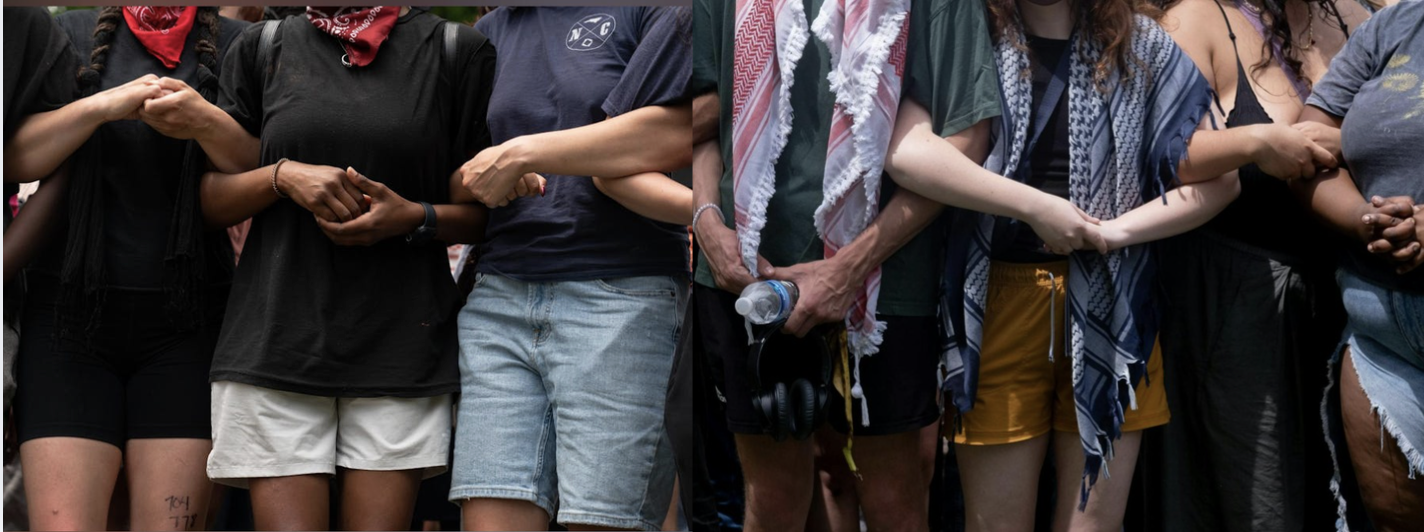
Okay, I don’t know if you remember the most beautiful thing that came from that day was like something that we didn’t call for or expect, but people naturally, just like linked arms in front of everyone that was on the stairs to protect them, and then there was just like, this chain of students actually being harassed and spit on and pushed and but people came to defend us, and that was so beautiful. That was so beautiful. That was when organizing happens on its own. You don’t have to plan anything, and people will protect each other. But yeah, that was really, really, really beautiful. And I’ll never forget that, people that have never attended a single one of our events, linking arms to protect students that were speaking on the stairs. It was beautiful.” — Lily
UNC SJP and community members rally on the steps of Wilson Library with signs and flags (Photo Courtesy of Clara Brennan)(Photo Courtesy of Clara Brennan)(Photo Courtesy of Kaitlin McKeown)UNC community organically forms human chain to protect UNC SJP members and speakers
The numbers alone indicated a strong interest on campus in justice for Palestine. There is a long history of Palestine organizing that indicates that any mention of Palestinian liberation necessitates the dissolution of the Israeli state, and therefore is antisemitic. This gathering was no exception. In response to the allegations of antisemitism following this rally, UNC SJP released a statement reading:
“We reject the characterization of the Oct. 12 rally or any of SJP’s other activities as antisemitic. Anti-Zionism and antisemitism are not the same — many of SJP’s executive board members are Jewish. Furthermore, we reject the assertion that supporting colonized peoples’ right to resistance is the same as endorsing violence in our community.”
UNC SJP dispelled, and to this day continues to dispel, these accusations of antisemitism by distinguishing the difference between Judaism and Zionism. They point out that these claims problematically erase the many Jewish students, staff, faculty, and community members involved in the fight for a free Palestine – many of whom were unjustly targeted because of their Pro-Palestine stances.12UNC SJP, “UNC SJP Responds to Hostile Campus Climate, Anti-Palestinian Racism,” The Daily Tar Heel, November 8, 2023, https://s3.amazonaws.com/snwceomedia/dth/dcd490fd-3233-4f7e-8b14-fb39832e0107.original.pdf It also erases the long history of antisemitism in Europe, which fueled the creation of the state of Israel in order to solve the regions‘ “Jewish” problem .
UNC-Chapel Hill students demonstrate during a pro-Palestinian protest at an encampment at UNC-Chapel Hill on Monday, April 29, 2024. (Photo Courtesy of Travis Long)
Additionally, in this statement, UNC SJP also called out the anti-Palestinian racism, anti-Arab bigotry, and Islamophobia on campus in which the administration revealed that it “values the life and well-being of certain students more than others… We condemn this lack of concern for Palestinians, especially given that we know UNC students whose family members have been killed during Israel’s indiscriminate bombing in Gaza.” 13Ibid UNC SJP pointed to the University administration’s lack of concern for Palestinian students at the October 12th rally, in which counter-protestors harassed the Pro-Palestine demonstrators. In the face of the University’s inaction, students, staff, and faculty responded to these verbal attacks by linking arms to protect the rally speakers. In response, religious studies professor Evyatar Marienberg verbally attacked student and faculty protestors by getting into their faces and calling them “Nazis.”14Estelle Venable, “Anti-Palestinian Discrimination Investigation Opens at UNC Following Complaint -,” The Daily Tar Heel, June 3, 2024, https://www.dailytarheel.com/article/2024/06/university-title-vi-investigation-anti-palestinian-discrimination.
The October 12th rally was not the only time the “administration’s lack of concern for Palestinian students and allies were on full display.”15UNC SJP, “UNC SJP Responds to Hostile Campus Climate, Anti-Palestinian Racism,” Following October 7th, University administration sent out emails providing resources to Israeli students, but not Palestinian students, and acquiesced to the University Trustee members’ “racist crusade against Students for Justice in Palestine.”16Miguel Cardona and Johnathan Smith, rep., Title VI Complaint Against University of North Carolina-Chapel Hill (Washington, Maryland, 2024).
UNC SJP Week of Action
October 23-27th 2023
Notwithstanding the University’s negligence and antagonism, UNC SJP continued to organize. Between October 23 and 27th 2023, UNC SJP hosted a “Week of Action,” a weeklong program aimed to bring campus attention to Palestine. On the last day of the Week of Action on Friday, Oct. 27, 2023, Pro-Palestine student protesters rallied on the steps of South Building and read their demands aloud.17@UNCSJP, “Week of Action (Oct 23-27th),” Instagram, October 21, 2023, https://www.instagram.com/p/Cyrv1yIgskM/?igsh=Y2J3Ym82NWU0ZGRo
UNC SJP called on then-Chancellor Kevin Guskiewicz, Provost Chris Clemens, and the Executive Administration of UNC Chapel Hill for the divestment of Israel’s war crimes and to end support for Israel’s apartheid occupation and settler colonialism in Palestine. In their open letter they wrote, “UNC materially invests in Israel’s systemic apartheid in the OPT [Occupied Palestinian Territory] by stocking Israeli products in stores, signing contracts with companies that assist Israel’s occupation, investing in assets and ETFs that support the military-industrial complex.” Their three demands included (1) disclosure and transparency in investment portfolios, (2) open dialogue with administration regarding divestment from apartheid, and (3) divestment from all products and contracts it maintains with Israeli or Israeli supporting companies.
Despite the letter’s delivery to South Building, multiple rallies, sit-ins, and numerous meetings with the Upper administration, University administrators did not yield to student demands. As a result of the administrative stonewalling and the refusal to engage in meaningful dialogue, UNC SJP turned to a new set of tactics to call attention to the ongoing genocide in Palestine and demand an end to the University’s complicity.
On November 17, UNC SJP, alongside other campus cosponsors, joined hundreds of student organizations across the US in a “March for Palestine.”18Julian Hill, “Pro-Palestine Students Occupy South Building, Demand University Action,” The Daily Tar Heel, November 20, 2023, https://www.dailytarheel.com/article/ad0c4eaa-d280-4a5b-a929-b710743c685f. Starting at noon on the steps of Wilson Library, UNC SJP refused to be “silent like the administration wants us to be” and marched on campus to the South Building.19 “ShutItDown4Palestine” to call for the University to divest.@UNCSJP, “March for Palestine,” Instagram, November 14, 2023https://www.instagram.com/p/Czp2JY8Ajkr/?img_index=1
Following a series of speeches, roughly 40 UNC SJP members and allied community members moved inside, occupying UNC’s administrative headquarters.20Julian Hill, “Pro-Palestine Students Occupy South Building, Demand University Action,” The Daily Tar Heel,
In a statement posted to Instagram, UNC SJP explained that this decision was not their first choice, but rather “a product of UNC’s choice to ignore us for three weeks” after they hand-delivered a list of demands in October. 21UNC Students for Justice in Palestine, “Statement on Our November 17th Sit-in at South Building ,” Google Documents, November 24, 2023, They explained that their demands for the University to materially divestment were time sensitive: “the number of Palestinians dead under Israeli siege rises steeply with each passing day… Israel has decimated Gaza’s medical infrastructure, leaving one operational hospital to serve a population of 2 million. There is no food, drinking water, or fuel in the Strip. More than 1 in 200 Gazans have lost their lives to this genocide.”22Ibid
For over three hours, UNC SJP members, students, and allied community members sat inside the South Building, read the names and ages of Palestinians who were killed, chanted, read poetry together, and heard from Arab and Palestinian students about their life experiences.23Ibid In response and in an ironic mirror of events in Palestine, the University Police refused students access to the bathrooms, food, and water. Administrative staff treated the student protestors as if they were not there, while others, like the Vice Chancellor of University Communications at the time, were recording and mocking students.
UNC SJP wrote in their statement:
“We came to South Building in good faith, yet found ourselves laughed at and dismissed by those who are supposed to be invested in our needs as students. The Chief of Staff was the only individual other than the Chief of Police to speak with us, yet her unwillingness to engage beyond a superficial level was an impediment to productive conversation. Ultimately, we were told that the building was closing early, and threatened with arrest and academic sanctions if we did not leave.” 24@UNCSJP, “November 17th Sit-in Statement,” Instagram, November 24, 2023, https://tinyurl.com/sjpsitin
UNC SJP and allied community members occupy South Building (Photo Courtesy of Clara Brennan)
On February 19th, 2024, UNC SJP and allied student and community organizations joined millions across the globe in the “March for Rafah” in response to Israeli strikes and military attacks on Gaza’s southern city of Rafah.25Daneen Khan, “Students March for Rafah, Demanding UNC Divestment from Companies with Connections to Israel – Daily Tar Heel,” The Daily Tar Heel, February 20, 2024, https://www.dailytarheel.com/article/2024/02/university-sjp-march-for-rafah. Rafah was a refuge for displaced Palestinians attempting to escape starvation, disease, and relentless Israeli bombardment. In an interview with the Daily Tar Heel, an UNC SJP member explained, “Rafah is currently Gaza’s most populated area, where 1.5 million people also are sheltering as their very last resort… and over half a million of these people are children.”26Ibid
UNC SJP and community members march through Chapel Hill and occupy Franklin Street (Photo Courtesy UNC SJP instagram)
Roughly around noon, following speeches from UNC SJP, N.C. State University SJP, and UNC Graduate Students for the Liberation of Palestine, the Triangle-area pro-Palestine crowd marched towards Franklin Street and occupied the roads.27Ibid This crowd collectively put their bodies on one of the busiest streets in Chapel Hill to disrupt people’s commutes and the public transportation system to bring attention to the ongoing atrocities in Rafah. Students and allied community members were using their signs, flags, and bodies to remind their local community that there could be no business as usual and demanded the University to divest materially from Israel’s military bombardment and genocide in Palestine.
(Photo Courtesy of UNC SJP Instagram)(Photo Courtesy of UNC SJP Instagram)(Photo Courtesy of UNC SJP Instagram)
As a part of “Apartheid Week” between March 18-22, 2024 – a week dedicated to raising global awareness to the Palestinian liberation struggle against Israel’s deep-seated and ongoing settler-colonialism and apartheid – UNC SJP hosted a “die-in.”28@UNCSJP, “Israeli Apartheid Week,” Instagram, March 12, 2024, https://www.instagram.com/p/C4a7sSQuJT7/ A “die-in” is a protest or demonstration where participants simulate being dead or lie down in a public place to draw attention to a specific issue.29Ibid
On March 21, dozens of students and triangle community members laid on the concrete ground at the bottom of the steps of South Building. For over four hours, UNC SJP leadership with long scrolls in hand read names of those killed by Israeli forces to “mourn and honor all the Palestinian martyrs as well as bring attention to the University’s complacency in the ongoing genocide in Palestine.”30@UNCSJP, “Die-in on the steps of South Building,” Instagram, March 25, 2024, https://www.instagram.com/p/C48llp1OiVg/?img_index=6 At one point of the die-in, a speaker turned towards South Building, making a moral appeal to the administrators inside,
“UNC, how many times and how many ways can I tell you that over 30,000 Palestinians have died, have been murdered? Millions displaced, thousands upon thousands under the rubble. How many infants starved to death will it take to make you react?”31Natalie Bradin and Dania Al Hadeethi, “UNC Students for Justice in Palestine Hosts Die-in Outside South Building -,” The Daily Tar Heel, March 25, 2024, https://www.dailytarheel.com/article/2024/03/university-sjp-die-in.
Disruption at Board of Trustees Meeting
On March 27 and 28 2024
Despite various attempts both inside and outside South Building to implore the University administration to withdraw financial contracts abetting the ongoing genocide in Palestine, no changes were made. Therefore, UNC SJP members pivoted their attention from South Building administrators to the UNC Board of Trustees. On March 27 and 28, 2024, UNC SJP members took part in a two-day series of protests at the UNC Board of Trustees’ meeting to demand University divestment.32Lauren Rhodes, “A Timeline of Students Calling for Divestment This Academic Year ,” The Daily Tar Heel, April 30, 2024, https://www.dailytarheel.com/article/2024/05/university-divestment-demands-timeline. The students of the University followed and confronted Trustees in the lobbies, disrupted board meetings, and waited outside and chanted.33@UNCSJP, “NO BUSINESS AS USUAL,” Instagram, March 29, 2024, https://www.instagram.com/p/C5HZhB5JkVK/
Trustees, Trustees you can’t hide. You are funding a genocide.
By occupying the pristine lobbies and disrupting meetings held in luxurious boardrooms, UNC SJP members created a spatial rupture within elite-designed University spaces.
The Carolina Inn, for example, boasts that it pioneers “what is now known as the Southern Colonial style, a mixture of Georgian, Neoclassical, and European influences,” with the original building modeled after Mount Vernon and an aesthetic that “embraces the feel of a plantation-style mansion.”34The Carolina Inn, Chapel Hill, NC: Historic Hotels of America,” Historic Hotels Worldwide, accessed March 20, 2026, https://www.historichotels.org/us/hotels-resorts/the-carolina-inn/.
Screenshot from Historical Hotels of America
The Carolina Inn represents a marker of the colonial, antebellum South, and continues to preserve these memories and legacies by accommodating University Trustees who seemingly also “embrace” the same white Confederate project. Just two years earlier at the Carolina Inn, the President of the Black Student Movement (BSM), Julia Clark, was punched in the face by UNC Police Officer Rahsheem Holland.35Kate Murphy and and Martha Quillin, “Black Student Leaders Want Acting UNC Police Chief Fired for ‘Assaulting’ Protesters ,” News & Observer , July 16, 2021, https://www.newsobserver.com/news/local/education/article252612673.html#storylink=cpy BSM students were physically forced to leave the BoT meeting regarding Nikole Hannah-Jones’ tenure – a meeting that these students were invited to attend.
“You are doing white supremacy. You are upholding white supremacy. You are white supremacy. In my face, you are white supremacy… Do not speak to me about diversity.” – Julia Clark in a video speaking to Board of Trustees
Like the student activists before them, UNC SJP and allied members directly confronted their University Trustees, a governing body composed largely of political appointees -many white, wealthy, and disconnected from the broader University population.
The UNC Racial Equity Task Force found that in 2020-2021, roughly 68% of all UNC trustees were white. It is important to note that the number of white UNC Trustees skyrocketed 84% when the system’s six historically minority serving institutions (HMSI) were excluded. American Association of University Professors’ 2022 Report of a Special Committee: Governance, Academic Freedom, and Institutional Racism in the University of North Carolina System highlighted that faculty who spoke to their committee felt that “more and more frequently new appointees to the boards have had little to no academic experience, their ties to local politicians and wealthy families having evidently been a more important consideration.”
These students unsettled these predominantly white elite governing boards by putting their bodies in spaces that unwelcomed their presence and reminded them of their complicity in sustaining both historical and ongoing genocide in Palestine. Their uncomfortable questions and relentless demands revealed the ways that this campus is “soaked in blood” and disturbed the white hegemonic social order.
Students leave red handprints on the UNC seal on Saturday, May 11 (Photo Courtesy of Heather Diehl)
“UNC has very tactfully framed itself as a liberal haven, but I would instead use the phrase a colonial paradise, because while it is very aesthetically pleasing, everything on this campus is soaked in the blood of Black people. Soaked in the tears of colonialism. Of displacement. Of gentrification. Of genocide.”36Salena Braye-Bulls, “Exclusive: Black Ink Speaks with BSM President Julia Clark about James Cates Jr.. Memorial,” Black Ink Magazine, September 2, 2022, https://uncblackink.com/2022/08/26/exclusive-black-ink-speaks-with-bsm-president-julia-clark-about-james-cates-jr-memorial/. – Julia Clark
In addition to using tools such as direct action and large demonstrations to secure immediate attention to Palestine, UNC SJP also channeled a large part of its organizing capacity into education. In between their protests and demonstrations, UNC SJP also hosted numerous community-oriented events on campus from teach-ins to poetry nights and panels.
(Photos Courtesy UNC SJP Instagram)
These students recognized the limitations of course catalogs and classroom lectures that did not or rarely addressed the histories of the world, let alone cover the history of Palestine. As a result, students took it upon themselves to carve out these spaces at the University by meticulously curating the necessary educational content, spreading promotional material, and cultivating spaces to educate the wider campus about Palestine.
In addition to expanding and deepening students’ collective understanding of Palestine, UNC SJP was also challenging the University’s authority over knowledge production. By questioning traditional educational modalities and adopting alternative modes of learning, UNC SJP engaged in what Paulo Freire describes as critical pedagogy. Freire critiques the “banking model of education,” in which teachers act as “depositors” of knowledge and students are treated as passive recipients.37Paulo Freire, Pedagogy of the Oppressed, trans. Myra Bergman Ramos (New York: Continuum, 2000) Rather than positioning teachers as the primary and exclusive holders of knowledge, Freire argues for replacing this model with a problem-posing approach that centers “the problems of human beings in their relations with the world.”38Ibid UNC SJP inverted the administration/professor/student hierarchy by determining for themselves what knowledge is valuable, who has the authority to produce and disseminate it, and how it should be used. In doing so, UNC SJP joined interdisciplinary departments in challenging the notion of students as static recipients of information and instead cultivated dynamic, relational engagements with the University and the rest of the world.
UNC SJP was not just challenging the mode of learning and adding more “representation” to campus, but these students were cultivating spaces that reimagined the role of what a student could be. These students asked themselves and each other what their responsibilities were as active participants of the University and active citizens of the world. What did it mean to be situated at a University profiting off militarism – inside the “belly of the imperialist beast” – while one of the most televised genocides happened across the globe? What was the responsibility of students who were citizens of the United States whose tax dollars fund such genocides? How would they speak truth to power in that instant?
Pro-Palestine protesters stand in front of the ROTC Armory during UNC-Chapel Hill’s Students for Justice in Palestine walk out for the West Bank on Thursday, Sept. 19, 2024. (Photo Courtesy of Viyada Soukthavone)
Within these communal learning spaces, students and community members engaged in the collective study of Palestine alongside the broader workings of the U.S. empire. These spaces were important because campus life carried on as normal: students attended lectures, studied at the library, and attended sports games on the weekends. These collective education spaces disrupted everyday routine to uncover and expose the violence that lay hidden at the University. These spaces resisted the normalization of the ongoing global genocide that would not have otherwise been acknowledged at the University.
These educational spaces facilitated the necessary mass political consciousness building that catalyzes and mobilizes into large-scale protests and demonstrations. It was not just about getting bodies of people to show up and chant outside of South Building, but also reshaping minds and helping people understand what they needed to know, why they needed to care, and why it was important to continue to show up.
UNC students and Chapel Hill community members dancing together at Triangle Gaza Solidarity Encampment on April 26, 2024. (Photo Courtesy of Kennedy Cox) A student protestor offers support to another student inside the “pro-Palestine encampment” barricade on Monday, April 29, 2024. (Photo Courtesy of Heather Diehl)
In summary, students through praxis – the practice of taking ideas generated in educational spaces and transforming them into material concrete changes – challenged the University through reconfiguring white elite spaces by attempting to first expose and then sever its financial and academic ties to Israeli apartheid and genocide in Palestine. In its place, students forged an alternative vision of an integrated anti-racist University untethered to US militarism in the Global South.
Special Rapporteur on the situation of human rights in the Palestinian territories occupied since 1967, “A/79/384: Report of the Special Rapporteur on the Situation of Human Rights in the Palestinian Territories Occupied since 1967, Francesca Albanese – Genocide as Colonial Erasure | Ohchr,” A/79/384: Report of the Special Rapporteur on the situation of human rights in the Palestinian territories occupied since 1967, Francesca Albanese – Genocide as Colonial Erasure, October 1, 2024, https://www.ohchr.org/en/documents/country-reports/a79384-report-special-rapporteur-situation-human-rights-palestinian.