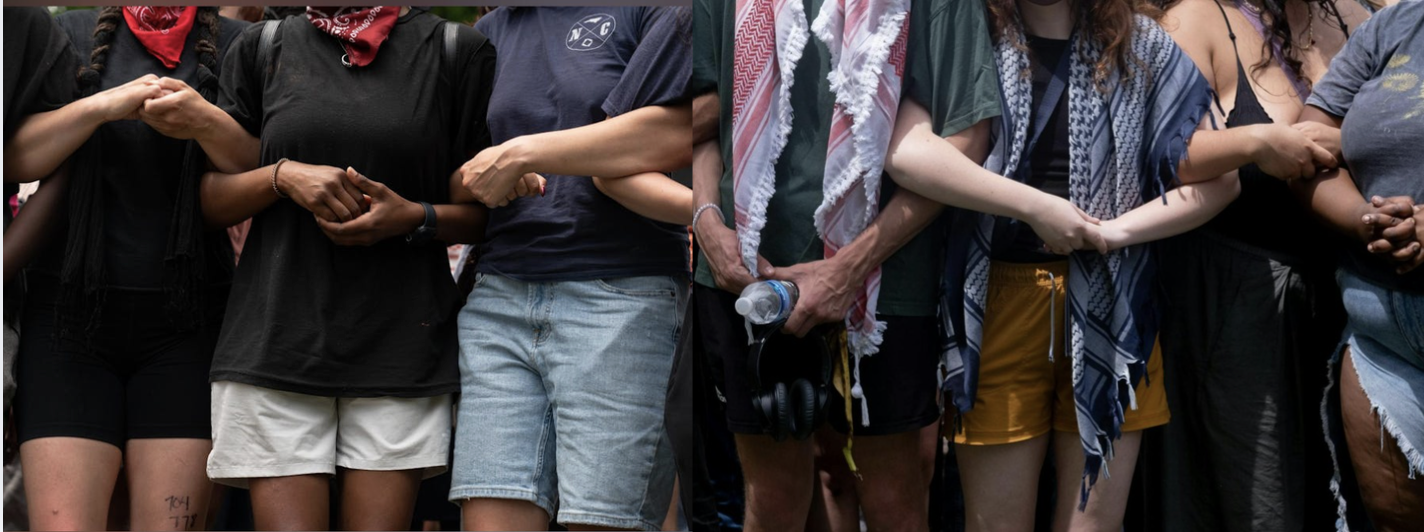
the Student Struggle Against the Re-Segregation of UNC Chapel Hill
The Role of the University
What makes a University public?
Today, nearly 19.5 million undergraduate and graduate students are enrolled in higher education institutions across the United States.1Melanie Hanson and Fact Checked, “College Enrollment Statistics [2025]: Total + by Demographic,” Education Data Initiative, March 17, 2025, https://educationdata.org/college-enrollment-statistics. As of 2025, approximately 73.2% of all college students across every level of higher education attend public institutions.2Ibid With lower in-state tuition, a wider range of financial aid options, and a larger, more diverse student body, public universities are essential to creating more accessible and inclusive pathways to higher education.
But public universities as we know them today did not form naturally, but rather they are the outcome of centuries of political, economic, and ideological struggle. In fact, the purpose of the University, specifically a public university, has been a long historically contentious debate. In the 19th century, the Populist movement sought to redefine the university’s obligations to the state and its citizens, challenging elite control over education and knowledge production.3Scott M. Gelber , The University and the People: Envisioning American Higher Education in an Era of Populist Protest (University of Wisconsin, 2011). Decades later in the 1960s, students challenged Eurocentric college curricula and demanded the expansion of African American, Chicano, Asian American, and Native American history and literature into the University. Students at the public institutions, San Francisco State University, and UC Berkeley, sparked the impetus of the student-led movements for ethnic studies across the nation in which students of color directly confronted their universities as colonial institutions consolidating wealth and upholding exclusion.4Gieg, Susan N., and Emily C. Miller. 2017. “An Examination of Student Protest in the Late 1960’s: A Case Study of San Francisco State and UC Berkeley.” Journal of the Student Personnel Association at Indiana University 44 (June):84-97. https://scholarworks.iu.edu/journals/index.php/jiuspa/article/view/23651. The late 1960s struggle transformed and solidified public universities as national battlegrounds over who is welcomed into the classroom, what is taught in the curriculum, and what/how knowledge is produced.
The University of North Carolina Chapel Hill has long served as one of these epicenters of struggle. As the first public university in the U.S. and the flagship university in North Carolina, UNC-CH serves as a case study for national debates and contentious racial issues that play out on its campus. From withholding unrepatriated Native American ancestral remains in its Archaeology Research Laboratories to severing the Black Student Movement’s co-ownership of the Upendo Lounge in 2025, the University frequently makes headlines as it continues to simultaneously confront and conceal its ties with settler colonial violence and legacy of slavery.5Laura Pellicer and Lilly Knoepp, “UNC-Chapel Hill’s Archeology Labs Continue to Hold the Remains of Hundreds of Native Americans,” WUNC News, July 26, 2023, https://www.wunc.org/news/2023-07-25/unc-chapel-hill-archeology-labs-hold-remains-hundreds-native-americans; Dallia Lindell, “UNC Dissolves Co-Ownership of the UPENDO Lounge with the Black Student Movement.,” Black Ink Magazine, October 31, 2025, https://uncblackink.com/2025/10/10/unc-dissolves-co-ownership-of-the-upendo-lounge-with-the-black-student-movement/.
In the face of all of this, the University proclaims itself as the “University of the People” with its mission of bringing lux et libertas (light and liberty) to North Carolina and bringing research to the people to improve.
Quote on wall of Fetzer Hall Offical University Website
Black, Indigenous, and allied activists and scholars have argued otherwise. Community activists like Danita Mason Hogans argue that until the University is truthful about its origins of racial violence, “this will be a University for some people, not University of the people.”6Caleb Herrera, “‘People Who Truly Built the University’: The Old Chapel Hill Cemetery Reflects UNC’s Racial History -,” Daily Tar Heel, February 4, 2025, https://www.dailytarheel.com/article/2025/02/university-cemetery-preservation. Former associate professor, William Sturkey, in response to the Nikole Hannah-Jones tenure decision, shared a similar sentiment “The people of the state of North Carolina fund our universities, but the people that lead them are only the wealthy elites. It was founded largely to educate wealthy, white, slave-owning children, and, basically, wealthy whites still run everything.”7Sarah Krueger et al., “Imminent Nikole Hannah-Jones Decision Brings UNC Board’s Diversity Issues to Light,” WRAL.com, June 29, 2021,
Not only was UNC founded on what Geeta Kapur writes as “[the] bedrock of white supremacy, racial injustice, and iniquity lands the University of North Carolina,” but also, it could not exist today without the theft from enslaved peoples in North Carolina and the dispossession of Native people from their land in North Carolina and Tennessee. Lucas P. Kelley & Garrett W. Wright in their article Without profit from stolen Indigenous lands, UNC would have gone broke 100 years ago, detail the University as a “land-theft” institution that “only survived the financial upheavals of the early 19th century—including multiple panics and national depressions—because they sold Cherokee and Chickasaw land.”8Lucas P. Kelley and Garrett W. Wright, “Without Profit from Stolen Indigenous Lands, UNC Would Have Gone Broke 100 Years Ago,” Scalawag, November 13, 2023, https://scalawagmagazine.org/2020/09/indian-land-university-profit/.
Despite being integral to the formation of the University, the descendants of those violently displaced and those “who had built the university with their sweat, blood, bodies, soul[s] and deferred dreams could not enter the institution as students. And so it was that, a century later, white supremacy, racial justice and iniquity remained the cornerstone and foundation of the nation’s first public university.”9Geeta N. Kapur and William J. Barber, To Drink from the Well: The Struggle for Racial Equality at the Nation’s Oldest Public University (Durham, NC: Blair, 2021). Even after the first Black students were admitted in the mid 1950s, with the University dragging their feet the entire time, racial hostility and violence persisted on campus. In 1969, Black women foodworkers with the support of the Black Student Movement went on strike to demand livable wages and dignified working conditions. In 1980, the Housekeepers Association filed a lawsuit grounded in the 13th Amendment, arguing that “badges and indices of slavery” were still in effect at the University.10Historical Memorandum, 1996 in the Alan McSurely Papers, #4928, Southern Historical Collection, Wilson Library, The University of North Carolina at Chapel Hill.
In the 21st century, the institutionalization of white supremacy continues at UNC-CH. kynita stringer-stanback writes that her ancestors were “intimately and intricately… connected to the building, growth, and preservation of our nation’s flagship public university” yet she and other descendants of enslaved peoples are “raddled with a six-figure debt that continues to increase” as a result of “institutionalized racism continues to ossify” instead of rectifying its past.11From Slavery to College Loans. Johns-Hopkins University Press. Library Trends, 68(2), October 1, 2019, https://escholarship.org/uc/item/4bs1c748
Student activists in the 21st century also continued to encounter racial hostility and violence reminiscent of the experiences faced by their predecessors. In 2018, activist Emil Little publicly denounced the Confederate monument Silent Sam, describing it as “a statue that advocates violence against us, that honors slave owners.” Little further recounted that, at the site, they had “felt degraded,” explaining that the statue was “a literal noose hanging on our campus, which is a memorial to violence towards black people, to the people who enslaved my ancestors and sold their children.”12Amy Goodman, “Meet Maya Little, UNC Student Whose Protest Ignited the Movement to Topple a Racist Confederate Statue,” Democracy Now!, August 22, 2018. Little during their time was subject to police surveillance, called racial slurs and violent threats, including being told she would be “hung from the tree right above Silent Sam.”13Ibid
This pattern of racial intimidation and resistance persisted into the subsequent decade, shaping the contours of campus activism in the 2020s. The 55th president of the Black Student Movement, Julia Clark, explained that the legacy of white supremacy and slavery continued into the present during her time at UNC.
“The reality is that systems and institutions like police departments that are descendants of carceral institutions like enslavement that are descendants of active institutions of white supremacy and hate groups that have participated. If you look at UNC police, they have participated when Proud Boys come on campus and they’re standing with them, they have decided that white men with guns are not a threat to safety on our campus, but Black students who are unarmed are”.
Student activist Derrick Derek, in his oral history, detailed how he and another student were targeted during the Pro-Palestine movement, and subsequently charged with a misdemeanor and trespassed for participating in an act of nonviolent direct action.
“I was also the only Black man there, probably the only person who looks like how I look with locks and everything… I guess they went back and checked the videotapes, and they started charging people. Laura also had received charges for it, which ironically, you have the person who has a disability, and also the Black guy being charged for this, because they can just pick out whoever they want. So we both got charged for disorderly conduct…. And they’re telling me I can’t come here because of a direct action and such a small task that I did, and they’re really just trying to silence me and other community members from speaking up against them. It’s just really wicked. Like, it’s really wicked.”
On March 13, 2025, ACLU and Emancipate NC filed a lawsuit against several UNC administrators alleging unlawful banning of pro-Palestine protestors from campus and violating their rights to free speech and due process.14Keisha Williams, ACLU of NC, Emancipate NC, and Muslim Advocates File Suit Against UNC, March 11, 2025, https://www.newsobserver.com/news/local/education/article301878474.html. UNC Students for Justice in Palestine member Hashem Amireh believed the University was “using false allegations” to silence him as a “prominent Palestinian voice advocating for Palestinian liberation on campus.”15Lena Geller, “‘something You Can’t Ignore:’ Q&A with Hashem Amireh, Who Was Suspended Following the pro-Palestine Protests at UNC,” The INDY, June 14, 2024, https://indyweek.com/news/something-you-cant-ignore-qa-with-hashem-amireh-who-was-suspended-following-the-pro-palestine-protests-at-unc/. International student activists, like Hashem, across the country were targeted with their academic careers jeopardized , financial scholarships terminated, and student visas threatened. In chapter two, I expand more on the weaponization of law and policy changes to crack down on student protestors like Hashem.
In the face of this history of and ongoing oppression, why is the University so adamant in calling itself the “University of the People” on its website and boasting about its progressive ideals during speeches? These contradictions are not unique to UNC-CH, but rather a common phenomenon amongst neoliberal universities. So, I will draw upon broader scholarship from Abby Fite, Roderick Ferguson, and Piya Chatterjee and Sunaina Maira on neoliberal higher education to situate UNC-CH within these wider structural trends and demonstrate how these tensions manifest across comparable institutions.
Abby Fite argues that universities desire an “equilibrium” and as a result move towards the “abatement of activism and the resumption of normal operations, and distinguished from the status quo only insofar as it permits a smattering of reform to de-escalate activists, defer dissent, and fortify the university against the next uprising.”16Abby Fite,“University Counterinsurgency: Campus Activism Under Attack” (dissertation, 2024). The 1960s and 70s demarcated an era in which minority students unsettled, disrupted and “challenged the university, they were calling for a new social and intellectual makeup of the university and for a new social order in the nation at large… pushing against the old (racist, patriarchal, classist homophobic) way of doing things.”17Roderick A. Ferguson, We Demand: The University and Student Protests (Oakland, CA: University of California Press, 2017). In the aftermath of these student movements, Universities institutionalized and absorbed demands not out of genuine desire for social transformation, but rather as a strategic means to pacify and dilute radical critique.18Roderick A. Ferguson, The Reorder of Things: The University and Its Pedagogies of Minority Difference (Minneapolis: University Of Minnesota Press, 2012).
As Roderick Ferguson argues, neoliberalism is not just “an economic and political formation involving governments and business but an ideological project meant to tear down the web of insurgencies that activists have been demanding.” Piya Chatterjee and Sunaina Maira contend that neoliberal universities function as a “racial strategy of management,” designed to regulate an increasingly diverse student population while maintaining existing power structures.
Chatterjee and Maira coined the “Imperial University” to describe the academic institutions that shape public discourse and cultural opinion to (re)produce and legitimize racist and imperialist logics. As a result, the academy, the center of knowledge production, is able to use its scholarship to uphold elite interests and racial hierarchies and justify US state-sactioned violence and global militarism. Historically, student movements and faculty dissent push back against these inner workings of academia, culture, and militarism. Thus, the suppression of student and faculty voices is not solely an attack on free speech but the regulation and constriction of academic knowledge production. Because marginalized students were not imagined into the University, they took it upon themselves to challenge the norm of the Universities and write themselves into the narrative. Therefore, it is important to see student movements as legitimate forms of intellectual investigations and contributions to the University.19Roderick A. Ferguson, We Demand: The University and Student Protests (Oakland, CA: University of California Press, 2017). The University rather than engaging with these ideological and intellectual ideas to bring about social transformation, adapted counterinsurgency practices to criminalize dissent and uphold the status quo.
Drawing on these works of scholarship and critiques of the academy, I argue that the university functions as a site that discretely reproduces white social order and racial hierarchies. At the same time, marginalized students who have valiantly fought for their admission and belonging at the University disrupted the institution’s white elite social fabric and exposed the ongoing ties to the Confederacy. In doing so, students forge a new understanding of the University as a site for challenging the status quo and demanding a more equitable world. To make this argument, I also draw from Charlotte Fryar’s “racialized landscape,” which describes the reciprocal relationship between cultural landscapes “the built environment—i.e., buildings, monuments, memorials, and other physical spaces,” and institutional processes “processes at work in creating a shared culture of white supremacy within the institution.” Essentially, these cultural landscapes covertly normalize a culture of white supremacy, and the institutional processes reproduce racial hierarchy as the status quo. Black students at the University subverted these dynamics and challenged the racialized landscape by reclaiming space and ownership of the University. They wrote themselves into the historical narrative. It was Black students, not the University, who worked restlessly to fulfill the university’s self- proclaimed democratic ideals of being the University of the People.
It is also important to acknowledge that Black, Indigenous, and other students of color were undoubtedly critical to reclaiming UNC=CH as the University of the people; however, this responsibility was shouldered by the very few students of color admitted to this University. Because of lack of access and restrictive college application process, students of color were in the minority and tokenized. They are expected to be exemplary students and subjected to micro/macro aggressions, while also shouldering the responsibility of fighting for a more just campus. The work student organizers do is vital, but it is exhausting. Our bodies and health become sacrificial to build a better University. Often, the same institution causing our emotional fatigue and chronic stress, decades later uses student movements as a PR stunt to advertise the University, without ever acknowledging their complicity.
Today, the University administration widely celebrates the many campus movements, from the fight for racial integration to the struggle for food workers’ rights. However, during the 1960s, when these movements were actively unfolding, the administration stood in the way of these social changes: the Board of Trustees passed a resolution barring the admission of Black students and later North Carolina Highway Patrol was called in to suppress the Food Workers’ Strike. 20Associated Press, “Last Student Who Helped Integrate the University of North Carolina’s Undergraduate Body Has Died,” WUNC News, May 17, 2024, https://www.wunc.org/race-class-communities/2024-05-17/last-undergrad-college-student-integrate-unc-died.
In November 2015, students in a letter to the administration titled “Collective Response to Anti-Blackness” called out this hypocrisy and calling the University an “unethical institution.”
You include Black and Brown bodies in the institution, and mark them with the words ‘diversity,’ ‘incision,’ and ‘multiculturalism.’ You throw us on brochures and tout us in statistics. You do this to hide the way UNC would not function were it not for the mass displacement, exploitation, slow death, and genocide of Black and Brown people. We are not trying to integrate into a violent system while others among our people are suffering both inside and outside the University.
Despite this fetishization, the University admits few Native and Black students. In the entering class of 2022, the University only had 0.3% American Indian (62) and 8.3% (1,669) Black undergraduate students. Since the ban of affirmative action policies, this number has only continued to fall.
When asked about the admission drop for Black students, the 2025-2026 president of the Black Student Movement Adam Sherif responded, “The Black makeup in North Carolina is about 20 percent. And so, when you look at UNC, the flagship university that was built on the backs of Black slaves, it’s disheartening to see that we went from about a 10.5 percent representation in years previous to the affirmative action case, to, now, 7.8 percent.”21Claire Harutunian, “Percent of Black Students Enrolled in Fall 2025 Remains Low Two Years after Affirmative Action Repeal – Daily Tar Heel,” Daily Tar Heel, September 9, 2025, https://www.dailytarheel.com/article/university-data-2025-admissions-demographic-updates-20250910.
In just the admission racial demographics alone, the University’s attempts (or lack thereof) to rectify the past are insufficient. It is certainly not any better now and arguably worse off. Scholars in critical ethnic studies, Black study, and critical race theory ask these questions of why racial disparities and discrimination persist: Why are there so few students of color on UNC-CH’s campus? How do we radically imagine what the University could be if we widened the net? How might we imagine a future in which more students of color are admitted, agitate the University, and shift the campus zeitgeist?
The questionis not just what a public university is, but also what it should be?
Scott M. Gelber , The University and the People: Envisioning American Higher Education in an Era of Populist Protest (University of Wisconsin, 2011).
4
Gieg, Susan N., and Emily C. Miller. 2017. “An Examination of Student Protest in the Late 1960’s: A Case Study of San Francisco State and UC Berkeley.” Journal of the Student Personnel Association at Indiana University 44 (June):84-97. https://scholarworks.iu.edu/journals/index.php/jiuspa/article/view/23651.
Geeta N. Kapur and William J. Barber, To Drink from the Well: The Struggle for Racial Equality at the Nation’s Oldest Public University (Durham, NC: Blair, 2021).
10
Historical Memorandum, 1996 in the Alan McSurely Papers, #4928, Southern Historical Collection, Wilson Library, The University of North Carolina at Chapel Hill.
Abby Fite,“University Counterinsurgency: Campus Activism Under Attack” (dissertation, 2024).
17
Roderick A. Ferguson, We Demand: The University and Student Protests (Oakland, CA: University of California Press, 2017).
18
Roderick A. Ferguson, The Reorder of Things: The University and Its Pedagogies of Minority Difference (Minneapolis: University Of Minnesota Press, 2012).
19
Roderick A. Ferguson, We Demand: The University and Student Protests (Oakland, CA: University of California Press, 2017).