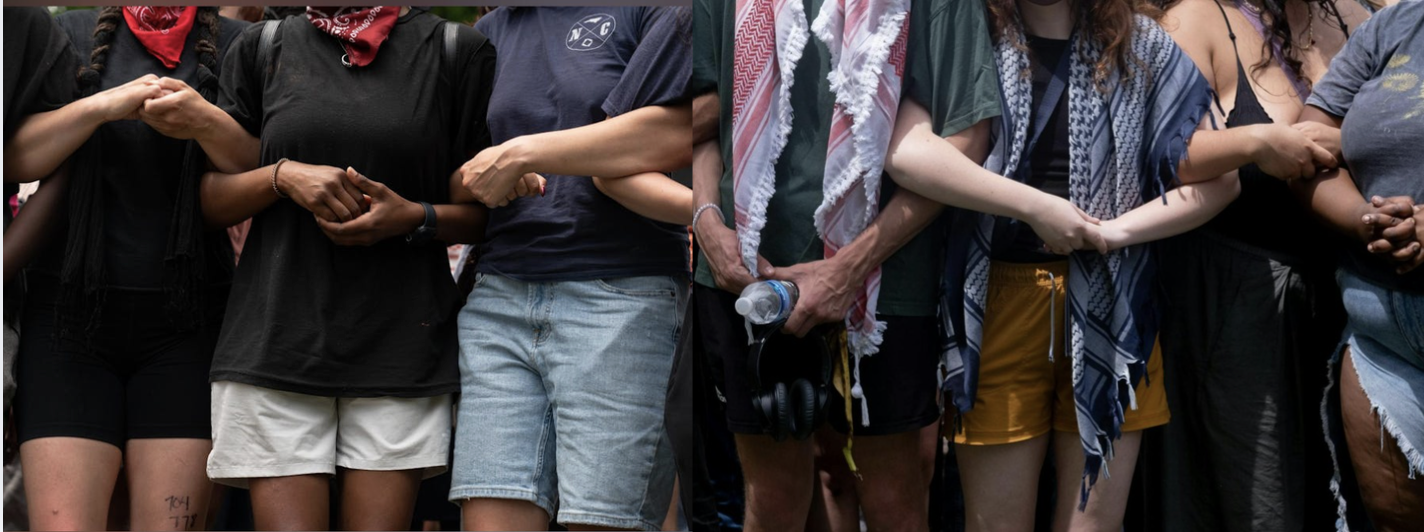
Do not scroll. This is my note to you, the reader. You might be a student, an administrator, an academic, an activist or a historian. Whoever you are, this website is for you. The curious individual eager to learn more about the past, the student activist, or historian searching for a more accurate telling of student movements in the 2020s. Or, possibly, you’re someone who stumbled across this website by total accident.
I began this project because of what was ignited internally within me, just like so many other student activists during our time at UNC. Something that could not be learned through a book or taught in the classroom. At the University of North Carolina Chapel Hill in the 2020s, we witnessed the power of student movements. From standing room only TransparUNCy teach-ins to the construction of the Gaza Triangle Solidarity Encampment, we felt the unstoppable fervor of students who wanted to change the campus. Students who wanted to change the world. So, I created this website to capture this insatiable and indescribable power, hunger and drive of students in the 2020s to share with you so that future generations can understand our struggles, feel the collective joy and to feel the strong pulse of our community solidarity at this moment. In doing so, I first hope to give the future generation a more holistic and accurate depiction of what actually happened. Secondly, I leave behind our lessons so that the future generation does not have to recreate the wheel and not to repeat our mistakes.
Student organizing is not easy; student movements do not naturally appear out of thin air. Through strategic planning and shared solidarity, we built a robust student-led coalition on this campus. We individually entered this work through a plethora of different issues: attacks on academic freedom, climate change, ban of affirmative action, and the genocide in Palestine. We stayed in this work and banded together in solidarity because all of these pressing issues are interwoven with each other. The challenges students confront can all be traced to a small group of decision-makers who are accused of operating behind closed doors, using encrypted, message-deleting apps to shape campus policies without transparency.1Matt Hartman, “Former Provost Sues UNC-Chapel Hill Trustees Over Closed Meetings,” The Assembly, September 22, 2025, https://www.theassemblync.com/education/higher-education/chris-clemens-lawsuit-scill.
Our collective demand for divestment and disclosure was directed at the same University governing bodies that defunded and gutted Diversity Equity Inclusion (DEI) programs while simultaneously funneling a large portion of that money into the UNC-CH Police Department– a police department that shook the hands of white supremacists openly carrying guns on campus during Silent Sam2.”UNC Board of Trustees Unanimously Votes to Slash Diversity Program, Divert Money to Public Safety,” ABC11 Raleigh-Durham, May 13, 2024, https://abc11.com/post/dei-funding-unc-board-of-trustees-diversity-program-diverts-money-to-public-safety/14808731/; Joe Killian, “UNC Students to Walk out over Police Policies toward White Supremacist, Anti-Racist Protesters • NC Newsline,” NC Newsline, April 24, 2019, https://ncnewsline.com/2019/04/24/unc-students-to-walk-out-over-police-policies-toward-white-supremacist-anti-racist-protesters/. Notably, the demographic of the University governing bodies of the UNC system and UNC-CH member makeup does not reflect the racial, gender and political demographic of its student or state population.3Christopher R. Marsicano and Rylie Martin, rep., A Brief Report Prepared for the Governor’s Commission on the Governance of Public Universities in North Carolina, 2022.


Students, lacking the financial and institutional power of upper administration, challenged their administration through demands, rallies, teach-ins, and disruptions and held them accountable. As a result, we became engulfed in a fight against the University, which became a larger project of a shared “transformative vision that can, in our own time, allow us to reimagine racial justice as a wider type of freedom, one capable of speaking to the many crises of our world.”4Daniel HoSang, A Wider Type of Freedom: How Struggles for Racial Justice Liberate Everyone (Oakland, CA: University of California Press, 2023). However, there is currently a gap in the research that weaves all these critical events at UNC Chapel Hill together. While there are a handful of newspaper articles and literature on the fall of affirmative action, ban on DEI policies, and the Pro-Palestine liberation student movement, this scholarship often addresses key events in depth and in isolation.
This thesis asks how might we understand the student movements at UNC Chapel Hill in the 2020s for equity, racial integration, and anti-colonialism in one cohesive narrative? These flashpoints are the product of the University’s enduring ties to systems of oppression, including its legacy of slavery and settler colonialism. I argue the chilling effects of affirmative action and DEI ban; slashes in humanities funding and programing; infringement on academic speech are all intertwined in the administration’s attempt to resegregate the University. This panoramic view of University politics through the spatial and temporal examination of student movements is inspired by Charlotte Fryar’s Reclaiming the University of the People. Fryar’s work documents roughly 67 years of Black student and worker movements at the University,beginning in 1951 with Black students desegregating the University and continuing through 2018 student-led toppling of the Silent Sam monument. Fryar’s work has been transformative in linking major historical events together and bringing them into the contemporary moment. Their work is quintessentially challenging how “liberal narratives of racial tolerance, non-violence, and civility supports and maintains white supremacy” and helping those doing resistance work today understand the long legacy of Black revolutionaries on this campus.5Charlotte Taylor Fryar, “Author Statement,” Reclaiming the University of the People, March 27, 2019, https://uncofthepeople.com/about/author-statement.
Fryar wrote as an interdisciplinary scholar who recognized the absence in the historical record of the University’s deep-seated anti-Black violence and recovered what she could from oral histories and the archives to fill in the gap. I come from a different perspective, as someone deeply entrenched in the organizing work I write about. Historical works written decades following major protests and movements provide crucial continuities and clarity to the larger picture. But it is inevitable that important nuances, stories, and people are lost in this time gap, which will be exacerbated by the current federal defunding of humanities projects and programs.
It is essential that we document while the struggle is still unfolding, while the thoughts and rage are fresh, and before University narratives of events still unfolding become the only narratives that matter. Moreover, it is important to note the constant revolving door of first-year students coming onto campus and senior students graduating from the University. This transient student body has severely prevented the transmission of stories and limited the student population’s institutional memory.
By capturing these voices now, while students in these movements are still in the area, it is so important to what histories get told and by whom. The University’s often sanitized history of itself cannot be the only telling of community stories about our collective past.
The University’s Narratives and Its Unraveling
During my first ever tour of the campus in April 2022, I was immediately bombarded with UNC Chapel Hill’s long-standing traditions: taking a sip from the Old Well on the first day of classes to rushing Franklin Street after beating Duke. Even before I was officially enrolled at this University, I was made aware of these shared ideas of what it means to be part of this community, to assume the label of a Tar Heel. I was overwhelmed, but eager and captivated by the upper quad with Wilson Library, the prestige status of a R1 research institution, the copious opportunities for academic research, and the prospect of so many fulfilling life-long friendships.


This University was a site of wonder and possibility.
However, the next four years on this campus, this idyllic image of UNC Chapel Hill began to unravel. The longer I interacted with this place, the more I came to understand that UNC Chapel Hill is not what was sold to me and so many other prospective students.
In 2015, the UNC Board of Governors voted to discontinue the UNC School of Law’s Center on Poverty, Work, and Community, which strived to study and ameliorate poverty in North Carolina.6Edward J. Graham, “Closure of Poverty Center in North Carolina,” AAUP, accessed October 29, 2025, https://www.aaup.org/academe/issues/101-4/closure-poverty-center-north-carolina. Two years later in 2017, UNC administration refused to remove a Confederate statue and instead spent $390,000 in just one year for police security. Ultimately, students took it upon themselves to pull down the Silent Sam statue.7Jane Stancill, “Protesters Topple Silent Sam Confederate Statue at UNC,” The News & Observer , August 21, 2018, https://www.newsobserver.com/news/local/education/article217035815.html. In 2020, the UNC Board of Trustees delayed Nikole Hannah-Jones’ tenure appointment, despite her exceptional academic scholarship.8Amanda Becker, “Nikole Hannah-Jones’ Delayed UNC Tenure Offer Highlights Political Battle over Critical Race Theory,” The 19th, June 30, 2021, https://19thnews.org/2021/06/nikole-hannah-jones-unc-tenure-decision. During my time, I attended numerous protests at South Building with campus workers demanding livable wages, accessibility on campus, and safety protections against gun violence.9Joe Killian, “Campus Workers Union to Rally, Deliver Demands to UNC Board of Governors • NC Newsline,” NC Newsline, February 23, 2023, https://ncnewsline.com/briefs/campus-workers-union-to-rally-deliver-demands-to-unc-board-of-governors/ accessibility on campus,10William Christensen, “Campus y Co-Presidents Protest UNC’s Lack of Accessibility for Physically Disabled Students,” Carolina Connection, March 3, 2023, https://carolinaconnection.org/2023/03/03/campus-y-co-presidents-protest-uncs-lack-of-accessibility-for-physically-disabled-students. and safety protections against gun violence.11Sophie Mallinson, “‘Nauseating Fear’: UNC Students Rally for Gun Control after Campus Shooting,” WUNC, September 1, 2023, https://www.wunc.org/news/2023-08-30/nauseating-fear-unc-students-rally-for-gun-control-after-campus-shooting. In 2023, workers asking for a $20 per hour wage were given a “disrespectful” 90-cent raise, bringing their pay to $16.18 per hour.12Lia Salvatierra, “UNC Housekeepers and Other Workers Deliver Demands to Board of Governors,” INDY Week, February 23, 2023, https://indyweek.com/news/unc-housekeepers-and-other-workers-deliver-demands-to-board-of-governors/#:~:text=%E2%80%9CHowever%2C%20now%20they’ve,at%20backtalk@indyweek.com
In 2026, UNC had more elevator outages than the year prior, with students who use wheelchairs reporting increased difficulty getting around campus and attending everyday lectures.13Victoria Deal, “UNC Had More Elevator Outages than Elevators Last Year. Some Are Still down – Daily Tar Heel,” The Daily Tar Heel , January 26, 2026, https://www.dailytarheel.com/article/university-elevators-broken-dey-carroll-inaccessibility-20260113.
Ultimately, the University’s response to the Triangle Gaza Solidarity Encampment irredeemably shattered my perceptions of the University. On April 20, 2023, administrators brought in police forces from across the state to beat, pepper-spray, and arrest peaceful student protestors.14Emmy Martin, “Six Arrested among 36 Pro-Palestinian Protesters Detained at Encampment at UNC Following Call to Disperse – Daily Tar Heel,” The Daily Tar Heel, April 30, 2023, https://www.dailytarheel.com/article/university-breaking-arrests-encampment-20240430. Despite photos and stories of assault and excessive force shared across social media and in the news, not a single officer was reprimanded.
The trust and respect I lost in University administration was instead placed into the hands of students, faculty, and community members. To this very day, when I walk past the quad in the evening, I am hit with a wave of nostalgia and longing. I can still faintly visualize our encampment tents, and I can hear the excited chatter and laughter.

For numerous days, despite the University’s threats and antagonism, we created a “liberated zone.” The name “liberated zone” captured our general feelings, while simultaneously we grappled with how the land was originally stewarded by Indigenous peoples, and it was never ours to reclaim. This complicated vocabulary of liberation spoke to the many tensions and nuances that we were forced to confront in this struggle towards freedom.
“I think I struggled with it a lot, and I would sometimes voice frustrations, but kind of chose my battles, and sometimes people would come up to me and ask me [what] my thoughts were because I’m Native, and I was just like “okay, I’ve got kind of bigger fish to fry. [Laughs] Like terminology isn’t my biggest thing. But I think the logic behind having a liberated zone is that it was an area that was being organized, and everything happening in these areas was done with the involvement of people who were going to be in those areas. So all the educational stuff that was happening at the encampment, like the layout of the encampment, who was allowed to be there or not there was in the idea of having a liberated zone, those decisions were made by the people there, and not University admin or whoever claims they have ownership of the campus. But I think my frustration with it is, it ignores all the history of enslavement that took to build those areas that we were on, the Native land that the campus is on, all the campus workers that actually maintain the area. I think it’s easy to say you have a liberated zone when you’re momentarily set up there, we were not there even a week. But to truly have a liberated zone, I think would require a lot more work than what happened. But I get the sentiment [Laughs]” — Tico.
In our fight for a free Palestine, we occupied the University’s land and radically re-imagined what a world with free food and water, free medical supplies, collective art making, and communal living would look like. Through this process we all developed such a deep care for one another. When we occupied Polk Place around noon on April 30th, I remember yelling repeatedly at students to disperse if they were not comfortable with violence as the police marched down the quad. People stayed planted to the land. Not a single person moved. Even when the University taunted and threatened us with violent officers, rifles, armored vehicles, zip ties, pepper spray and career-ending expulsion, there was no doubt in anyone’s mind but to resist.

What began as a demand for disclosure and divestment from the University evolved into an entirely new way of living and seeing the world. The encampment was an investigation into what this place could be. We trusted and believed in the strangers around us to uphold their responsibility in alternative worldmaking. Together, we deconstructed hierarchies and transcended borders. The austere labels of undergraduates, graduate students, faculty, and Triangle community members dissipated in this shared space where we shared meals together, collectively learned about the past, held interfaith services, and laid our sleeping bags next to one another. It didn’t matter who you were or why you came to the University; all that mattered was our shared commitment to a liberated Palestine.
This experience awakened something in many of us. Something that the University could not even fathom. A commitment beyond claiming a degree and gaining job security, but also a deep yearning for total liberation and settling for nothing less. A desire to be part of a community that goes beyond wearing Carolina blue and tailgating on game day, but rather has a deep commitment and responsibility to one another locally and globally.
Days following the encampment, the photos and news of the encampments erupting across the country made its way to Gaza. Kids in Gaza posted pictures of themselves holding signs and writing on walls in English, thanking University students.

These photos and the October 2025 ceasefire two years later are reminders of why we continue this work and put our careers, reputation, safety, and lives on the line to disrupt business as usual. We saw how we might begin to change the world. We saw how we might salvage a University that upholds U.S. militarism abroad and perpetuates the legacy of white supremacy through the employment of officers with documented histories of violence against women and women of color, and statements committing to compliance with I.C.E.15Aisha Baiocchi, “UNC Police Officer Remains on Force despite Accusations of Violence toward Protesters -,” The Daily Tar Heel, September 9, 2024, https://www.dailytarheel.com/article/2024/09/sp-holland-police-accountability. and statements committing to compliance with I.C.E.16Lizeth Torres-Tomas, “UNC-Chapel Hill Decides to ‘Comply’ with Ice Orders on Campus,” Enlace Latino NC, January 31, 2025, https://enlacelatinonc.org/en/unc-chapel-hill-decides-to-comply-with-ice-orders-on-campus.
Because when the University fails to keep us safe, the people of the University keep us safe. We witnessed this collective safety as I drafted this very introduction in October 2025. Our administration put UNC’s beloved professor Dwayne Dixon on administrative leave, banned him from campus, prohibited from speaking to any UNC student and denied him pay.17Caleb Herrera, “Timeline of UNC Professor Dwayne Dixon’s Placement on Administrative Leave – Daily Tar Heel,” The Daily Tar Heel , October 7, 2025, https://www.dailytarheel.com/article/university-dwayne-dixon-leave-timeline-20251008. Through community outrage and legal counsel, Dixon was reinstated two days later.

Photo from Daily Tar Heel by Harrison Lennon
During a Campus Y panel on Academic Freedom with Hồng-Ân Trương, Dwayne Dixon said faculty across the nation similarly are feeling intense repression, but during his whole ordeal, he was supported and felt “so strong” because he was “in a community of strong powerful people.” He says that this community “will grow with you” and you may not see “the mechanical facets and forces at work… [but] you will be protected.” As a result of this community support and safety network, Dixon responded “I won’t be intimidated” and during these times of intense repression and censorship, “we fucking stand up.”
At this political moment, our public and private institutions are monitoring professors’ classrooms and syllabi are being monitored. Last year, University administrators surveilled and effectively fired, Larry Chavis, a Lumbee professor at Kenan Flagler Business School who is outspoken about queer rights and protecting DEI policies.18Jeffrey Billman,“UNC-CH Professor Cut after Recording Controversy Files Suit,” The Assembly NC, February 6, 2025, https://www.theassemblync.com/news/education/higher-education/larry-chavis-lawsuit-unc-chapel-hill-kenan-flagler/. In this summer 2025, Janique Sanders and Megan Pugh, administrators in the UNC system, were secretly recorded by external conservative organizations and subsequently fired.19Lilly Knoepp, “WCU Leader in Undercover DEI Video No Longer Employed,” BPR, June 12, 2025, https://www.bpr.org/text/bpr-news/2025-06-12/wcu-leader-in-undercover-dei-video-no-longer-employed. It is not just professors feeling the University administration squashing free speech. From the FBI infiltrating BSM in the 1960s, to undercover cops and social media tracking technology during Silent Sam, student activists inherit UNC’s long history of policing, surveillance, and infiltration to repress them. In 2025, UNC SJP representatives pointed out the University’s use of these tactics to “target recognizable and vocal students” following UNCPD’s use of excessive force, in which officers assaulted Laura Saavedra in her home while serving a warrant for her phone.20Aisha Baiocchi, “‘They Knew That They Used Excessive Force’: Student Activist Served Search Warrant – Daily Tar Heel,” The Daily Tar Heel, October 1, 2024, https://dailytarheel.com/article/student-serving-story-longer-version-20241001. Notably this was the second time UNCPD officers had physically assaulted Laura and knocked her out of her wheelchair.21Ibid
“It’s an effort to intimidate and silence students… They’re going to keep doing it, but at the end of the day, we’re there, they’re not going to be able to silence us.” – UNC SJP representative.
Like so many organizers around me, we persist and “stand fucking up” in spite of these threats and consequences. I document in defiance and write to agitate. I am not the only one agitating and unsettling the University’s hegemonic narratives; this thesis situates itself in many ongoing conversations. As one of many students, I write with great humility. I write in my voice and from my racialized and gendered experiences. From the perspective of an Asian American woman to whom has had administrators and heads of departments consistently advise me to be diplomatic and be “realistic” throughout my time at Carolina, essentially imploring me to be a good quiet Asian.22Christina Huang, “Failed Asian American Literature Hire Exemplifies Racism in the English Department,” MONSOON, accessed November 6, 2025, Notably, this is the same Asianness that has provided me with many opportunities, making attending the University of North Carolina Chapel Hill possible. As Ijeoma Oluo reminds us, to check our privilege often and leverage it “to make real, measurable change toward a better world.”23Ijeoma Oluo and Bahni Turpin, So You Want to Talk about Race (Solon, OH, ©2020: Findaway World, LLC, 2020). So, I subvert the racist assumption that all Asian women are docile, subdued, and conquerable. Instead of abiding by the model minority myth, I subversively write to challenge the University’s attempts to perpetuate its hostile status quo and weaponized narratives.
The University’s response to the Triangle Gaza Solidarity encampment exemplified one of the manipulations of narrative and imagery to delegitimize student activism. Following the police raid of the encampment, Chancellor Lee Roberts circulated a mass email to the campus community featuring photographs of the demolished encampment. The images displayed in the official email, framed the encampment as unsanitary and a threat to campus safety, served to justify the excessive police force used against protesters. By distributing only select decontextualized images, Lee Roberts and the administration fabricated a reality that painted student demonstrators as irrational and violent. Their portrayal omitted all evidence of the community care that defined the encampment: the educational workshops, food stations, medical booth, accessibility-focused walkways marked with red tape, and the student-made art posters calling for divestment. By providing a limited view into the encampment, the University not only distorted public perceptions of the encampment but also attempted to rewrite the historical record, removing traces of collective organization, mutual aid, and mass student demands for divestment. This site is a scholarly intervention into this misrepresentation and distortion of student movements. It utilizes oral histories, data, photographic evidence, and analysis of narratives of student actions, to disrupt the University’s attempt to portray student protest as anathema to University values.
A Brief History of UNC’s Relationship to the Confederacy
In the 1850s, UNC fired Professor Benjamin Hendrick for opposing slavery.24Geeta N. Kapur, To Drink from the Well: The Struggle for Racial Equality at the Nation’s Oldest Public University (Durham, NC: Blair, 2021). In 1970, James Lewis Cates was murdered by a white supremacist motorcycle gang in the Pit as he was leaving a community dance promoting interracial solidarity.25Mike Ogle, “James Cates Is Gone,” James Cates is Gone, November 18, 2020, https://stonewalls.substack.com/p/james-cates-is-gone. He would have lived if campus police had allowed him to seek medical care. 26Ibid In 2015, when students demanded building names be changed from enslavers and KKK leaders, the Board of Trustees voted to freeze building name changes for 16 years, which was repealed a few years later. But that didn’t stop Board of Trustees member John Preyer from calling for a “day of forgiveness” for enslavers.27Jessica Ruf (EDU), “UNC-Chapel Hill to Remove Names of Racist Figures from Four Campus Buildings,” The EDU Ledger, July 30, 2020, https://www.theeduledger.com/demographics/african-american/article/15107449/unc-chapel-hill-to-remove-names-of-racist-figures-from-four-campus-buildings. In 2018, when white supremacist militias marched onto our campus illegally carrying guns for Silent Sam, UNC campus police responded by shaking the hands of these members.28Joe Killian, “UNC Students to Walk out over Police Policies toward White Supremacist, Anti-Racist Protesters • NC Newsline,” NC Newsline, April 24, 2019, https://ncnewsline.com/2019/04/24/unc-students-to-walk-out-over-police-policies-toward-white-supremacist-anti-racist-protesters/. These officers deployed pepper spray and rammed antiracist protesters with bicycles while escorting the neo-Confederate hate group ACTBAC NC from a rally. 29Blake Hodge, “Police Increase Presence, Use Pepper Spray at Silent Sam Rally,” Chapelboro.com, August 31, 2018, https://chapelboro.com/news/unc/increased-police-presence-pepper-spray-used-silent-sam-rally.


Our administration has chosen the type of history it wants to write, have you?
It may seem like a daunting task but it has historically always been students, staff and faculty who have taken up this mantle. It was Black students who fought to have James Lewis Cates’ memory preserved in a memorial in the Pit. It was students in 2018 who wore nooses around their necks on campus, alongside 80 teaching assistants and instructors withholding nearly 2,200 final grades to successfully protest the proposal to build a new $5 million facility to house Silent Sam.Blake Hodge, “Silent Sam Protests Continue with Student Wearing Noose on Campus,” Chapelboro.com, December 13, 2018, https://chapelboro.com/news/unc/unc-student-wearing-noose-on-campus-to-protest-silent-sam-proposal; Lisa Philip, “UNC Teaching Assistants Put Jobs, Educations on Line to Protest Silent Sam,” WUNC News, December 14, 2018, https://www.wunc.org/education/2018-12-13/unc-teaching-assistants-put-jobs-educations-on-line-to-protest-silent-sam.; Lisa Philip, “UNC Teaching Assistants Put Jobs, Educations on Line to Protest Silent Sam,” WUNC News, December 14, 2018, https://www.wunc.org/education/2018-12-13/unc-teaching-assistants-put-jobs-educations-on-line-to-protest-silent-sam. It was student leaders in the Black Student Movement who created mutual aid networks in the face of the University’s negligence in COVID-19 response and provided over $40,000 in funds to Black students in need.30Julia Clark, Interview by Christina Huang, January 29 2026, Oral History Interview, Chapel Hill, NC It was students who created an anti-racist text alert system to warn students on campus when white supremacists were on campus and threatening students of color.31Charlie McGee, “UNC Anti-Racist Alerts’ Notify Students of Confederates on Campus,” The Daily Tar Heel, September 4, 2019, Volume 127, Issue 34 edition.
It is daunting, but these stories are reminders that it is not impossible. So, I write to invite you to join me in this task of playing an active role and picking up a pen to narrate the unfinished student revolution for the University of the People.