the Student Struggle Against the Re-Segregation of UNC Chapel Hill
Post Encampments
The arrests, suspensions, and bans of UNC SJP members alongside the expulsion of the student organization shrank the capacity of UNC SJP and were a major blow to the student movement.
Photo Courtesy UNC SJP Instagram
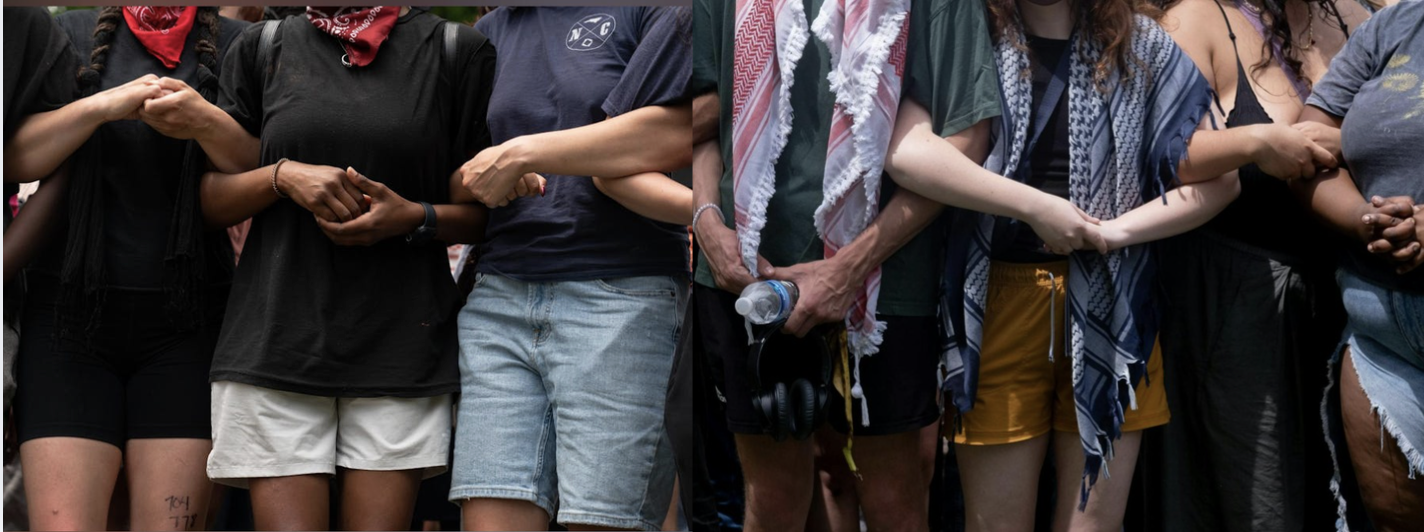
After a two year legal battle, all criminal charges and University charges have since been reduced or dropped. Those with charges stuck together in the courtroom, and adapted a “collective defense strategy”. Collective defense is a decarceral strategy in which defendants use their collective power to take on criminal legal proceedings. The defendants all chose to participate in collective defense to prevent students facing more serious charges from being left behind.1Statement from Chapel Hill Palestinian Liberation Defendants on July 30th, 2024,” the outside agitator, August 6, 2024, https://theoutsideagitator.com/2024/08/06/statement-from-chapel-hill-palestinian-liberation-defendants-on-july-30th-2024/.
“As we fight for our charges to be dropped, we remain focused on the goal of Palestinian liberation, and we hope to leverage our current situation to galvanize further support for our movement, showing the administration that their oppression will backfire.”2Ibid
Today, all encampment criminal charges have been reduced or dropped. In the one case that went to trial, the judge ruled that the University administration had failed to prove its trespass notice was valid or constitutional, making the violence that students experienced nothing more than a public-facing media stunt to gain support for retrograde views about the University and its people that were not commonly held or supportable with evidence.
The Disciplinary Charges
Alongside the criminal charges, students also faced University disciplinary charges. Previously students with disciplinary charges would go through the Student Honor Court. However, during this time, the University administration were in the process of dismantling the Student Honor Court, which conveniently gave the chancellor and administration oversight over the judicial prosecution of students.
ScreenshotScreenshotFirst two slides of TransparUNCy Instagram Post explaining the administration attempts to bypass student honor court
For the first time, student protestors were also being charged by Emergency Evaluation and Action Policy and Procedures (EEAC). The EEAC is a process overseen by administrators and UNC police that allows for the suspension of students who pose a threat to other students on campus. Important to note that the EEAC is a safety protocol not a disciplinary process. This process was misused to give the police and administration, who carried out the violent sweep of the encampment, the authority to also judge whether those students can be suspended without due process.
“The EEAC is draconian. The judge and the executioner are the same dude. The prosecution and the judge are the same.” – Hashem.
Hashem, despite not facing criminal charges, was still suspended through the EEAC. On April 30, he stepped in to defend a student protester who was being placed in a chokehold by a counterprotester. The incident was taken out of context the next day in The News & Observer, depicting Hashem as part of the heated struggle over the American flag coming down.
In reality, Hashem was pulling off an aggressive counterprotestor off a student. Hashem followed up by protecting the counterprotestor and was seen doing so from other Pro-Palestine people.
He was subsequently suspended from the University.
Even though his suspension was lifted and charges were dropped, after enduring months of harassment from professors in his department and University administrators, Hashem “lost all faith in the University” did not complete his PhD program and finished with a Masters degree. UNC student leaders like Hashem and Lily were subjected to years of harassment and faced long term personal and professional consequences.
“The University and community members and Sloan, I mean, doxed so many people that they were scared to leave their homes, their families in other states were afraid for their jobs and livelihoods. So that was one form of oppression that was very effective and horrible and really difficult to avoid, which kind of gets into the cybersecurity side of things. But students were trespassed, suspended and couldn’t attend school. I did not graduate until a couple of months ago, which is now two years later, which affected my life because I wanted to go to grad school, and I can’t apply to grad school if I don’t have a graduation certificate. Also, my family stopped speaking to me for a while, which I know is the same for a lot of students, because the University has control over the narratives that our families see. And I mean even more than all of those personal things, like the landscape of this university and most public universities in the United States is forever changed. Now we see what can happen in moments of dissent, which dissent is historically a successful and powerful student tool that is has been respected by administrations in history, but dissent is no longer allowed, and like now, we have seen the violence of those consequences, and so I think repression and suppression has worked so well that, like a lot of a lot of the movement has been stunted.” — Lily.
The aftermath of the encampment revealed the ways the University administrators consolidated power to squash oppositional dissent. From revisions to the EEAC disciplinary process to the dismantling of the student-led Honor Court to adding restrictions to free speech and assembly policies to the creation of the UNC Task Force, the University authoritarian policy changes made organizing on campus significantly more difficult.
We [UNC SJP] got banned. We got banned and we got banned again, or we got suspended, and then we got tried, and then we broke the student court. And so now the University administrators run the student court because the student court found that actually, we weren’t that bad, and we weren’t guilty of what they accused us for, which is funny, because it shows that the rules don’t matter, because they can just change the rules, which they did. So yeah, we’re banned. But also, UNC has a lawsuit against them for anti-Palestinian racism, so we call you illegitimate… Bro, because authoritarians, they’re just like grabbing at anything to squash anything that moves. And they’re going for everything. And cameras went up everywhere, both building cameras and classroom cameras and flock cameras tracking license plates. So the surveillance is more prominent and obvious than it was previously. — Sophia.
It was not just about who was being disciplined, but also whose political opinions weren’t being monitored and suppressed. Students and community members pointed out the administrative hypocrisy.
“They hide behind this, antisemitism bullshit, which is just so not accurate and untrue. But then in Lee Roberts’s presence, one of his police officers spits twice on the Palestinian flag, which is a clear violation of discrimination, etc, and nothing happens. The double standard is so fucking obvious that police officer, I think he’s UNC Health, actually, not UNC Police Department, UNC Health police department. But there’s definitely a viewpoint of discrimination, those Zionists are just so they’re powerful, they know the system is stacked in their favor, and they just operate this way. Yeah, they don’t give a fuck. He doesn’t give a fuck that in his presence a police officer is that works for him spat on the Palestinian flag. There was no comment. There was no mass email about it. Pro-Palestine voices are not welcomed, they’d rather silence us, and that’s what they’re trying to do. I mean, there’s this video from a body cab footage where you can hear a police officer, UNC police, I think he says, a journalist sent it to me wondering if it was in reference to me, and I’m not sure if it was in reference to me. He says, “Oh, that guy’s a loud mouth. We should arrest him.” Literally explicit, if we know who that was in reference to, as evidence of trying to repress speech. Can’t be more explicit than that.” — Hashem.
Pro-Palestinian voices were disproportionately targeted by the administration, and speaking out carried serious consequences. Despite knowing these consequences, students still exposed themselves to state violence, took countless risks, and made sacrifices because they were dedicated to this liberation project. Because they realized that this work was bigger than themselves.
“It came with some consequences, obviously. But again, at the end of the day, I’m fine. I’ll be fine even if they try to detain me, like they did to Mahmoud Khalil, which was a real possibility we were preparing for at some point. Luckily, thankfully, lawyers, including my immigration lawyer and other lawyers, and the North Carolina ACLU prepared a habeas petition to file immediately in case they do detain me. But even if I spend 100 days in ICE detention and I get deported. Yes, it fucks up, it does, but I’ll be fine. I’m not the one who’s living in a freezing tent in Gaza with just life being completely destroyed for millions of people. That’s why I think it feels a little weird to dwell on my journey when it really pales in comparison to what’s happening. I think that also informs my risk tolerance, informs my calculus of why I do the things I do, and I think people just don’t want… like if we go beyond Palestine and talk about America’s rapid descent into fascism. There’s so much cognitive dissonance about how insane and serious this is that people are not willing to take risks. They’re not willing. And it might be too late when people realize that this is not something where you should worry about your job or your individualistic needs. This is about something bigger than you.” – Hashem
Nevertheless the movement persists
The University’s undemocratic and relentless crackdown on pro-Palestine voices on campus, along with the burden of preparing for criminal court cases, was paralyzing for UNC SJP.
UNC SJP was charged multiple times and later banned. The majority of UNC SJP’s membership were preparing and responding to their ongoing criminal charges limiting organizing capacity over the summer when UNC SJP planned for the school year. Many of these defendants were also indefinitely banned from campus. 3Tico, Interview by Christina Huang, January, 28 2026, Oral History Interview, Huang American Studies Senior Thesis, Carrboro, NC
On their Instagram, UNC SJP explains in a statement that the administration was “trying to kill SJP on multiple fronts”. However, the student movement cannot be suspended. 4@UNCSJP, “We’re Not Going Anywhere,” Instagram, August 23, 2024, https://www.instagram.com/p/C_BrhFVPkuT/“
UNC SJP Instagram post response to suspension of the organization and University repression
And so, organizing for a liberated Palestine and future raged on. This is not an exhaustive list, given space and time restraints, but it is important for the historical record to reflect the resilience of the student’s resistance movement post 2023 in continuing to fight for disclosure and divestment on campus despite major setbacks.
ro-Palestine protesters outside ROTC Armory (Photo Courtesy of Heather Diehl)Pro-Palestine protesters march into the halls of Dey Hall (Photo Courtesy of Viyada Soukthavone) Pro-Palestine protesters stand in front of the ROTC Armory (Photo Courtesy of Viyada Soukthavone) Pro-Palestine protesters outside ROTC Armory (Photo Courtesy of Grace Richards)